Robotic Watchdog Brings Security To Modern Agriculture
 ✖  |
Agriculture has embraced many forms of autonomy, including GPS-guided tractors that plant with remarkable precision, drones that monitor crops and apply inputs, and equipment that delivers smarter, faster and more data-driven harvesting. Now, autonomous security is stepping into the future with Asylon Robotics’ DroneDog.
“Robotic security is the logical next step to protect high-value equipment, sophisticated production systems, infrastructure, animals and vulnerable crops,” says Asylon Robotics’ Vice President Kurt George. “We believe it’s a perfect way to extend autonomous advancement in the agricultural industry.”
The appeal of DroneDog and its technology isn’t that it looks futuristic, but that it fills a gap left by traditional systems. Static cameras only see forward. Human guards are costly, limited by fatigue, and not always eager to investigate a suspicious alert in harsh weather at 3 a.m.
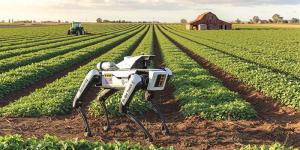
The mobile quadruped DroneDog features optical and thermal cameras, along with optional components such as gas detection, all on a platform that moves, adapts and responds. With two-way audio and encrypted recording, it documents incidents, warns intruders, and creates a record useful for insurance claims or post-incident review.
“There are no blind spots with the DroneDog,” George says. “It’s constantly gathering information for whenever it might be needed.”
DroneDog’s capabilities fit well in orchards, vineyards and other high-value operations in widespread or remote areas that face outsized economic risk, including trespassing, vandalism, theft and even fire. In wildfire-prone regions, the robot’s thermal imaging detects hotspots or drifting embers before they become catastrophic. In an era when response time can mean the difference between a close call and a devastating loss, early detection matters.
To remain patrol-ready, DroneDog recharges in its DogHouse, a dedicated docking station powered by standard 120-volt power or solar energy. The unit uses LTE connectivity rather than a complex fixed network. With a patrol speed of just over 3 mph, it runs for about 90 min before returning to its charging station. Multiple DogHouses can be daisy-chained for extra-large properties.
Mobility is another key advantage. DroneDog can climb grades up to 37.5 degrees, even in snow and ice, and move easily through mud, dirt or gravel.
“That’s why it’s a quadruped instead of on wheels, so it doesn’t get stuck,” George says. “It can go up and down stairs and even climb over large rocks or other obstructions.”
DroneDog can patrol autonomously or be operated remotely from Asylon Robotics’ security operations center in Pennsylvania. Routes are initially mapped using satellite imagery, then refined on-site as staff walk the robot through the property. Once learned, the routes become part of a standard operating procedure and can be repeated without a human escort, though operators continuously monitor the live video feed.
If something unusual occurs, an operator can take manual control, investigate, issue warnings via two-way audio (such as “Are you hurt?” “Are you lost?” or “Are you aware that we’ve called the police?”), and decide whether to contact the property owner, emergency responders or law enforcement.
Just as important, George explains that robotic patrols needn’t be framed as a replacement for people. They can complement human security by handling the dull, dirty and potentially dangerous parts of the job.
Asylon Robotics offers its services worldwide under an annual contract, providing security at roughly $30 per route, with each route typically lasting about 1 hr.
“We offer the service as X number of patrols per day, and 24/7 ready alert monitoring in the background, all-inclusive,” George says.
What makes this concept worth watching is where it may go next.
“As machine learning improves, the DroneDog robotic patrol system will begin to identify threats, not requiring 100% human identification,” George states. “It’ll soon distinguish between routine activity and real threats, between species of wandering animals, intruder variations, vehicle models, or the first signs of a fire. These capabilities will make them more than remote-controlled cameras on legs, allowing them to respond and react accordingly.”
Contact: FARM SHOW Followup, Asylon Robotics, Norristown, Penn. (kgeorge@asylonrobotics.com; www.asylonrobotics.com).
Click here to read entire issue
Robotic Watchdog Brings Security To Modern Agriculture
Agriculture has embraced many forms of autonomy, including GPS-guided tractors that plant with remarkable precision, drones that monitor crops and apply inputs, and equipment that delivers smarter, faster and more data-driven harvesting. Now, autonomous security is stepping into the future with Asylon Robotics’ DroneDog.
“Robotic security is the logical next step to protect high-value equipment, sophisticated production systems, infrastructure, animals and vulnerable crops,” says Asylon Robotics’ Vice President Kurt George. “We believe it’s a perfect way to extend autonomous advancement in the agricultural industry.”
The appeal of DroneDog and its technology isn’t that it looks futuristic, but that it fills a gap left by traditional systems. Static cameras only see forward. Human guards are costly, limited by fatigue, and not always eager to investigate a suspicious alert in harsh weather at 3 a.m.
The mobile quadruped DroneDog features optical and thermal cameras, along with optional components such as gas detection, all on a platform that moves, adapts and responds. With two-way audio and encrypted recording, it documents incidents, warns intruders, and creates a record useful for insurance claims or post-incident review.
“There are no blind spots with the DroneDog,” George says. “It’s constantly gathering information for whenever it might be needed.”
DroneDog’s capabilities fit well in orchards, vineyards and other high-value operations in widespread or remote areas that face outsized economic risk, including trespassing, vandalism, theft and even fire. In wildfire-prone regions, the robot’s thermal imaging detects hotspots or drifting embers before they become catastrophic. In an era when response time can mean the difference between a close call and a devastating loss, early detection matters.
To remain patrol-ready, DroneDog recharges in its DogHouse, a dedicated docking station powered by standard 120-volt power or solar energy. The unit uses LTE connectivity rather than a complex fixed network. With a patrol speed of just over 3 mph, it runs for about 90 min before returning to its charging station. Multiple DogHouses can be daisy-chained for extra-large properties.
Mobility is another key advantage. DroneDog can climb grades up to 37.5 degrees, even in snow and ice, and move easily through mud, dirt or gravel.
“That’s why it’s a quadruped instead of on wheels, so it doesn’t get stuck,” George says. “It can go up and down stairs and even climb over large rocks or other obstructions.”
DroneDog can patrol autonomously or be operated remotely from Asylon Robotics’ security operations center in Pennsylvania. Routes are initially mapped using satellite imagery, then refined on-site as staff walk the robot through the property. Once learned, the routes become part of a standard operating procedure and can be repeated without a human escort, though operators continuously monitor the live video feed.
If something unusual occurs, an operator can take manual control, investigate, issue warnings via two-way audio (such as “Are you hurt?” “Are you lost?” or “Are you aware that we’ve called the police?”), and decide whether to contact the property owner, emergency responders or law enforcement.
Just as important, George explains that robotic patrols needn’t be framed as a replacement for people. They can complement human security by handling the dull, dirty and potentially dangerous parts of the job.
Asylon Robotics offers its services worldwide under an annual contract, providing security at roughly $30 per route, with each route typically lasting about 1 hr.
“We offer the service as X number of patrols per day, and 24/7 ready alert monitoring in the background, all-inclusive,” George says.
What makes this concept worth watching is where it may go next.
“As machine learning improves, the DroneDog robotic patrol system will begin to identify threats, not requiring 100% human identification,” George states. “It’ll soon distinguish between routine activity and real threats, between species of wandering animals, intruder variations, vehicle models, or the first signs of a fire. These capabilities will make them more than remote-controlled cameras on legs, allowing them to respond and react accordingly.”
Contact: FARM SHOW Followup, Asylon Robotics, Norristown, Penn. (kgeorge@asylonrobotics.com; www.asylonrobotics.com).
To read the rest of this story, download this issue below or click
here to register with your account number.