Michigan Museum Houses World’s Largest Steam Pump
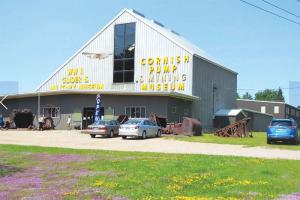
The world’s largest steam-driven water pump, built by E.P. Allis, a forerunner of Allis-Chalmers, is on display at the Cornish Pumping Engine and Mining Museum in Iron Mountain, Mich. It’s a modern engineering marvel, featured on the History Channel and in other documentaries. Those who’ve seen it say it’s not to be missed.
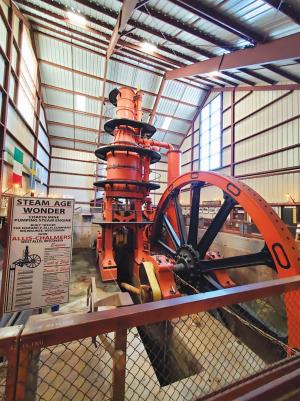
Museum visitors are overwhelmed by the size of a 725-ton steam-powered pump. A crew of 60 men, divided into three 20-man shifts, was required to run the pump 24/7. The mine where it operated employed nearly 2,000 men. The pump’s engine is 54 ft tall and measures 75 ft front to back. The 40-ft dia. flywheel weighs 160 tons. Running “full steam,” the engine could pump more than 3,100 gpm, equivalent to 191,000 gal/hr and more than 4.59 million gal in 24 hr.
Visitors to the museum ask, “Why is it so big? Why does it pump so much? Where did all that water go?” These are good questions, answered by operators of the Chapin Mine, a company specializing in underground iron ore mining in the late 1800s. Ore deposits deep underground were accessible only after water was pumped out of the shafts. The huge Cornish pump could move millions of gallons every day. Built over 3 years and put into operation in 1892, the monstrous pump was used until 1932. In that time, the mine produced more than 27 million tons of iron ore.
After sitting idle for 2 years, the engine was donated to Dickinson County and designated for sightseeing. During WWII, it was nearly dismantled for scrap metal, but locals saved it. The county later donated it to the Menominee Historical Foundation, which built a museum around it. The pump and the building it’s housed in are now listed on the National Register of Historic Places.
In its heyday, the steam engine produced 1,200 hp and turned the flywheel at a maximum of 10 rpm. It consumed almost 1,000 tons of coal per month to power a 24-in. dia. drive shaft connected to a series of eight pumps. Each pump had 28-in. plungers that lifted water in stages to the surface, where it was discharged into natural waterways, a common practice in mining operations at the time.
The Mining Museum also displays a large collection of underground mining equipment, including ore cars, hammers, tuggers, scrapers, skips, man cars and a dynamite car.
Contact: FARM SHOW Followup, Cornish Pumping Engine and Mining Museum, 300 Kent St., Iron Mountain, Mich. 49801 (ph 906-774-1086; mrhmuseum@gmail.com; www.menomineemuseum.com).

Click here to read entire issue
Michigan Museum Houses World’s Largest Steam Pump
The world’s largest steam-driven water pump, built by E.P. Allis, a forerunner of Allis-Chalmers, is on display at the Cornish Pumping Engine and Mining Museum in Iron Mountain, Mich. It’s a modern engineering marvel, featured on the History Channel and in other documentaries. Those who’ve seen it say it’s not to be missed.
Museum visitors are overwhelmed by the size of a 725-ton steam-powered pump. A crew of 60 men, divided into three 20-man shifts, was required to run the pump 24/7. The mine where it operated employed nearly 2,000 men. The pump’s engine is 54 ft tall and measures 75 ft front to back. The 40-ft dia. flywheel weighs 160 tons. Running “full steam,” the engine could pump more than 3,100 gpm, equivalent to 191,000 gal/hr and more than 4.59 million gal in 24 hr.
Visitors to the museum ask, “Why is it so big? Why does it pump so much? Where did all that water go?” These are good questions, answered by operators of the Chapin Mine, a company specializing in underground iron ore mining in the late 1800s. Ore deposits deep underground were accessible only after water was pumped out of the shafts. The huge Cornish pump could move millions of gallons every day. Built over 3 years and put into operation in 1892, the monstrous pump was used until 1932. In that time, the mine produced more than 27 million tons of iron ore.
After sitting idle for 2 years, the engine was donated to Dickinson County and designated for sightseeing. During WWII, it was nearly dismantled for scrap metal, but locals saved it. The county later donated it to the Menominee Historical Foundation, which built a museum around it. The pump and the building it’s housed in are now listed on the National Register of Historic Places.
In its heyday, the steam engine produced 1,200 hp and turned the flywheel at a maximum of 10 rpm. It consumed almost 1,000 tons of coal per month to power a 24-in. dia. drive shaft connected to a series of eight pumps. Each pump had 28-in. plungers that lifted water in stages to the surface, where it was discharged into natural waterways, a common practice in mining operations at the time.
The Mining Museum also displays a large collection of underground mining equipment, including ore cars, hammers, tuggers, scrapers, skips, man cars and a dynamite car.
Contact: FARM SHOW Followup, Cornish Pumping Engine and Mining Museum, 300 Kent St., Iron Mountain, Mich. 49801 (ph 906-774-1086; mrhmuseum@gmail.com; www.menomineemuseum.com).
To read the rest of this story, download this issue below or click
here to register with your account number.