Autonomous Irrigation Expands Farm Options
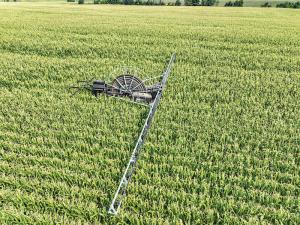 ✖  |
360 RAIN is designed for row-crop and specialty-crop growers, as well as livestock producers. It stands out as an adaptive application machine that autonomously delivers water, nutrients, manure and other liquid inputs, either banded or broadcast. Even fields with irregular shapes and corners are no problem for 360 RAIN.
The 3-wheeled, diesel-electric hybrid machine is tall enough to navigate full-canopy crops. It operates autonomously, laying out and retrieving up to 3,000 ft of 3-in. hose while following GPS-guided paths. Each component connects to a riser at the water source. A base station runs on standard 110-volt AC power and is pre-wired for communications and control, connecting to the unit via GPS and cellular networks. Farmers can integrate multiple sensors and relays for wells, pumps and injector systems to ensure smooth operation.
To apply manure or nutrients, the optional 360 Injection Skid blends and meters liquid inputs, offering variable rates via the 360 RAIN app. The system adapts to a wide range of water sources, including lagoons and reservoirs, and requires 200 to 250 gpm at about 115 psi. Liquids can be blended simultaneously, with variable-frequency drives (VFDs) controlling pump speed and application rates. The system includes components for water boosting, manure delivery and fertilizer injection. If needed, booster pumps can be added to meet pressure demands.
Using the smartphone app, farmers can manage and monitor their operations remotely, 24/7, making it convenient, efficient and sustainable.
“The 360 RAIN path planning begins at the planter,” says 360 RAIN’s Eastern North America Sales Manager Loren Weaver. “A GPS receiver mounted on the planter records every pass across the field, and this data is used to generate the paths and obstacles to guide the machine’s autonomous navigation. A dedicated RTK GPS receiver on the unit communicates with a base station near the field, allowing it to follow the created paths.”
Farmers start 360 RAIN from the app. It drives between crop rows, laying and retrieving hose along backbone paths. Separate front and rear booms automatically switch manifolds based on direction, ensuring water is always applied behind the wheels.
“One machine covers around 200 acres (give or take, depending on multiple factors), running at an average flow rate of 150 to 200 gpm,” Weaver says. “It runs autonomously, 24/7, with the farmer monitoring and adjusting everything remotely via the app, including speed, application rate, liquid system settings, engine performance, fuel level and individual drive motor amp draw.”
What sets 360 RAIN apart is its ability to efficiently “spoon-feed” resources directly to the root zone. For row crops, a banded drop applies water and nutrients directly over the root zone, doubling the benefit compared to broadcast methods while minimizing evaporation and nutrient loss. For crops like wheat and alfalfa, a flat-fan drop provides broader coverage, while custom drops serve specialty crops such as potatoes and onions.
“This banding approach means the plant effectively sees two times the benefit compared to a broadcast application, because the water and nutrients are concentrated right where uptake occurs,” Weaver says. “It also eliminates the evaporation losses common in overhead pivot systems and significantly reduces nutrient leaching, volatilization and runoff.”
The 360 RAIN is more than a drought mitigation solution. It tackles perennial farming headaches: labor shortages, manure pit management, rising input costs, and maximizing the value of overhead irrigation. Livestock producers can empty manure pits in-season, and crop growers can boost efficiency and yield potential with more targeted input applications.
With continuous, autonomous operation of up to 600 hr per fill, farmers gain valuable time to focus on other aspects of their business or family life. The system also includes a variable-rate feature in beta, allowing farmers to fine-tune input delivery via prescription map zones.
Currently, 360 RAIN sells about 200 units annually in more than 10 countries.
“Nothing else out there does autonomous, full-field coverage with multi-input capability all in one machine,” Weaver says.
Pricing varies by setup, but a local dealer can quickly map a field and provide a customized quote.
Contact: FARM SHOW Followup, 360 RAIN, 180 Detroit Ave., Morton, Ill. 61550 (ph 309-245-7514; help@360yieldcenter.com; www.360rain.com).
Click here to read entire issue
Autonomous Irrigation Expands Farm Options
360 RAIN is designed for row-crop and specialty-crop growers, as well as livestock producers. It stands out as an adaptive application machine that autonomously delivers water, nutrients, manure and other liquid inputs, either banded or broadcast. Even fields with irregular shapes and corners are no problem for 360 RAIN.
The 3-wheeled, diesel-electric hybrid machine is tall enough to navigate full-canopy crops. It operates autonomously, laying out and retrieving up to 3,000 ft of 3-in. hose while following GPS-guided paths. Each component connects to a riser at the water source. A base station runs on standard 110-volt AC power and is pre-wired for communications and control, connecting to the unit via GPS and cellular networks. Farmers can integrate multiple sensors and relays for wells, pumps and injector systems to ensure smooth operation.
To apply manure or nutrients, the optional 360 Injection Skid blends and meters liquid inputs, offering variable rates via the 360 RAIN app. The system adapts to a wide range of water sources, including lagoons and reservoirs, and requires 200 to 250 gpm at about 115 psi. Liquids can be blended simultaneously, with variable-frequency drives (VFDs) controlling pump speed and application rates. The system includes components for water boosting, manure delivery and fertilizer injection. If needed, booster pumps can be added to meet pressure demands.
Using the smartphone app, farmers can manage and monitor their operations remotely, 24/7, making it convenient, efficient and sustainable.
“The 360 RAIN path planning begins at the planter,” says 360 RAIN’s Eastern North America Sales Manager Loren Weaver. “A GPS receiver mounted on the planter records every pass across the field, and this data is used to generate the paths and obstacles to guide the machine’s autonomous navigation. A dedicated RTK GPS receiver on the unit communicates with a base station near the field, allowing it to follow the created paths.”
Farmers start 360 RAIN from the app. It drives between crop rows, laying and retrieving hose along backbone paths. Separate front and rear booms automatically switch manifolds based on direction, ensuring water is always applied behind the wheels.
“One machine covers around 200 acres (give or take, depending on multiple factors), running at an average flow rate of 150 to 200 gpm,” Weaver says. “It runs autonomously, 24/7, with the farmer monitoring and adjusting everything remotely via the app, including speed, application rate, liquid system settings, engine performance, fuel level and individual drive motor amp draw.”
What sets 360 RAIN apart is its ability to efficiently “spoon-feed” resources directly to the root zone. For row crops, a banded drop applies water and nutrients directly over the root zone, doubling the benefit compared to broadcast methods while minimizing evaporation and nutrient loss. For crops like wheat and alfalfa, a flat-fan drop provides broader coverage, while custom drops serve specialty crops such as potatoes and onions.
“This banding approach means the plant effectively sees two times the benefit compared to a broadcast application, because the water and nutrients are concentrated right where uptake occurs,” Weaver says. “It also eliminates the evaporation losses common in overhead pivot systems and significantly reduces nutrient leaching, volatilization and runoff.”
The 360 RAIN is more than a drought mitigation solution. It tackles perennial farming headaches: labor shortages, manure pit management, rising input costs, and maximizing the value of overhead irrigation. Livestock producers can empty manure pits in-season, and crop growers can boost efficiency and yield potential with more targeted input applications.
With continuous, autonomous operation of up to 600 hr per fill, farmers gain valuable time to focus on other aspects of their business or family life. The system also includes a variable-rate feature in beta, allowing farmers to fine-tune input delivery via prescription map zones.
Currently, 360 RAIN sells about 200 units annually in more than 10 countries.
“Nothing else out there does autonomous, full-field coverage with multi-input capability all in one machine,” Weaver says.
Pricing varies by setup, but a local dealer can quickly map a field and provide a customized quote.
Contact: FARM SHOW Followup, 360 RAIN, 180 Detroit Ave., Morton, Ill. 61550 (ph 309-245-7514; help@360yieldcenter.com; www.360rain.com).
To read the rest of this story, download this issue below or click
here to register with your account number.