Double-Crop Tomatoes Now Possible
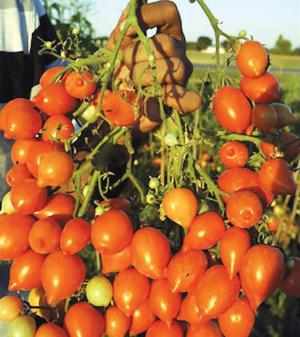
Desert Dew could change the way tomatoes are grown. The compact, 12-in. high plants require only 6 to 8 weeks to go from seed to fruit. They mature quickly enough that two crops might be grown even in northern states. The yet-to-be-released variety is the third short-season tomato developed by Dr. Changbin Chen, Arizona State University.
“I started work on Desert Dew while at the University of Minnesota, where we developed and released Ground Jewel and Ground Dew,” says Chen. “We’ve evaluated all three lines for indoor farming potential. They’re self-pollinating and a compact form that lends itself to greenhouse production. You can grow them in a very small space, like a patio or pot, and produce a pretty decent amount of tomatoes for salads or snacks.”
Of the three, Desert Dew yields heavier fruit and slightly more per plant, although it doesn’t produce as much as Ground Jewel.
Desert Dew contains significantly higher levels of Vitamin C than conventional red tomatoes. Chen describes the flavor of the 2 to 4-in. fruit as citrusy.
“They’re not slicing tomatoes, as they have a higher juice content,” says Chen. “They yield as much as 3 lbs. of fruit per plant and only take up about 1 sq. ft. of space. They’d be a good variety for a small farm that wanted to diversify by producing for farmers markets.”
The new variety was created through traditional, non-GMO plant breeding methods. Chen started by crossing two varieties and selecting for the traits he wanted. While at the University of Minnesota, these traits included fast growth and quick maturity to avoid season-ending frost. In Arizona, he found that high temperatures were bookended by two short growing seasons. Desert Dew and its older sisters performed well in both regions.
Unlike hybrid tomatoes, Desert Dew breeds true. While it doesn’t produce many seeds, they’ll reproduce faithfully. Ironically, while this is good for home gardeners, it reduces its value to seed companies since anyone can save seeds for personal use. As a result, this complicates the release of the new tomato to growers.
“We’re looking for a seed company to license Desert Dew and market it,” says Chen. “The University would like a return on the research conducted to produce Desert Dew.”
Contact: FARM SHOW Followup, Changbin Chen, 427 E. Tyler Mall, LSE 617, Tempe, Ariz. 85281 (ph 602-543-4688; cchen347@asu.edu).
Click here to download page story appeared in.
Click here to read entire issue
Double-Crop Tomatoes Now Possible
Desert Dew could change the way tomatoes are grown. The compact, 12-in. high plants require only 6 to 8 weeks to go from seed to fruit. They mature quickly enough that two crops might be grown even in northern states. The yet-to-be-released variety is the third short-season tomato developed by Dr. Changbin Chen, Arizona State University.
“I started work on Desert Dew while at the University of Minnesota, where we developed and released Ground Jewel and Ground Dew,” says Chen. “We’ve evaluated all three lines for indoor farming potential. They’re self-pollinating and a compact form that lends itself to greenhouse production. You can grow them in a very small space, like a patio or pot, and produce a pretty decent amount of tomatoes for salads or snacks.”
Of the three, Desert Dew yields heavier fruit and slightly more per plant, although it doesn’t produce as much as Ground Jewel.
Desert Dew contains significantly higher levels of Vitamin C than conventional red tomatoes. Chen describes the flavor of the 2 to 4-in. fruit as citrusy.
“They’re not slicing tomatoes, as they have a higher juice content,” says Chen. “They yield as much as 3 lbs. of fruit per plant and only take up about 1 sq. ft. of space. They’d be a good variety for a small farm that wanted to diversify by producing for farmers markets.”
The new variety was created through traditional, non-GMO plant breeding methods. Chen started by crossing two varieties and selecting for the traits he wanted. While at the University of Minnesota, these traits included fast growth and quick maturity to avoid season-ending frost. In Arizona, he found that high temperatures were bookended by two short growing seasons. Desert Dew and its older sisters performed well in both regions.
Unlike hybrid tomatoes, Desert Dew breeds true. While it doesn’t produce many seeds, they’ll reproduce faithfully. Ironically, while this is good for home gardeners, it reduces its value to seed companies since anyone can save seeds for personal use. As a result, this complicates the release of the new tomato to growers.
“We’re looking for a seed company to license Desert Dew and market it,” says Chen. “The University would like a return on the research conducted to produce Desert Dew.”
Contact: FARM SHOW Followup, Changbin Chen, 427 E. Tyler Mall, LSE 617, Tempe, Ariz. 85281 (ph 602-543-4688; cchen347@asu.edu).
To read the rest of this story, download this issue below or click
here to register with your account number.