Plants Issue Red Alert When N Deficient
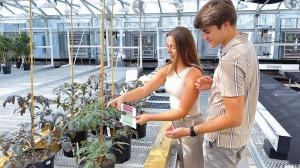
Two Cornell University doctoral students engineered tomato plants to turn red when soil nitrogen (N) levels are low. The RedAlert Living Sensors technology could be applied to countless other crops grown in gardens, greenhouses and open fields. Engineered sentinel plants, positioned periodically, could visually alert gardeners, farmers or hydronic growers to apply N.
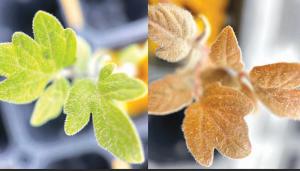
Ava Forystek and Jacob Belding used a native plant pathway where roots detect nitrogen and signal other parts of the plant. The tomato plants were genetically engineered to produce a red pigment when the root zone N was low. The shade of red indicated the level of available N.
Plants often yellow and wilt when N is deficient. By that point, the damage has already occurred. RedAlert gives the plant a voice before harmful effects happen, explains Forystek.
“We like to use the analogy of a dog that whines when it’s hungry,” she says. “It would be kind of ridiculous to wait until you feel its ribs to feed it.”
Forystek and Belding recently received the Graduate Runner-Up Award at the Collegiate Inventors Competition for the RedAlert Living Sensors. The National Inventors Hall of Fame runs the event. They received a $5,000 cash award and a U.S. Patent Office Patent Acceleration Certificate.
The two graduate students are exploring the development of a smartphone app that would correlate plant leaf color with root-zone N levels.
Belding notes that most “smart” ag tools tend to be sophisticated and expensive systems.
“This could be a smart ag device that’s affordable and can be easily used by even a home gardener,” he says.
Contact: FARM SHOW Followup, Ava Forystek, Beebe Hall, Ithaca, N.Y. 14853 (aif38@cornell.edu) or Jacob Belding, Olin Hall, Ithaca, N.Y. 14853 (jlb638@cornell.edu).
Click here to download page story appeared in.
Click here to read entire issue
Plants Issue Red Alert When N Deficient
Two Cornell University doctoral students engineered tomato plants to turn red when soil nitrogen (N) levels are low. The RedAlert Living Sensors technology could be applied to countless other crops grown in gardens, greenhouses and open fields. Engineered sentinel plants, positioned periodically, could visually alert gardeners, farmers or hydronic growers to apply N.
Ava Forystek and Jacob Belding used a native plant pathway where roots detect nitrogen and signal other parts of the plant. The tomato plants were genetically engineered to produce a red pigment when the root zone N was low. The shade of red indicated the level of available N.
Plants often yellow and wilt when N is deficient. By that point, the damage has already occurred. RedAlert gives the plant a voice before harmful effects happen, explains Forystek.
“We like to use the analogy of a dog that whines when it’s hungry,” she says. “It would be kind of ridiculous to wait until you feel its ribs to feed it.”
Forystek and Belding recently received the Graduate Runner-Up Award at the Collegiate Inventors Competition for the RedAlert Living Sensors. The National Inventors Hall of Fame runs the event. They received a $5,000 cash award and a U.S. Patent Office Patent Acceleration Certificate.
The two graduate students are exploring the development of a smartphone app that would correlate plant leaf color with root-zone N levels.
Belding notes that most “smart” ag tools tend to be sophisticated and expensive systems.
“This could be a smart ag device that’s affordable and can be easily used by even a home gardener,” he says.
Contact: FARM SHOW Followup, Ava Forystek, Beebe Hall, Ithaca, N.Y. 14853 (aif38@cornell.edu) or Jacob Belding, Olin Hall, Ithaca, N.Y. 14853 (jlb638@cornell.edu).
To read the rest of this story, download this issue below or click
here to register with your account number.