2025 - Volume #49, Issue #6, Page #03
[ Sample Stories From This Issue | List of All Stories In This Issue | Print this story
| Read this issue]
Rare Elgin Is One-Of-A Kind
 |

“I guess I’m genetically predisposed to old tractors because my dad collected and restored them before I was born,” Jansen says. “As a five-year-old, I was already begging him to take me to antique tractor shows.”
Motivated by their love for old iron and mechanics, Jansen and his brother Kent worked with their dad in his automotive and old-tractor repair business, eventually taking it over in 1986. Along the way, they’ve collected and restored their own tractors. The Elgin is a prime example.
Jansen’s friend, Jason Habing, owned the Elgin, and, like Jansen, he had never seen another one like it. Eventually, Jansen traded a Rumely Oil Pull to acquire it.
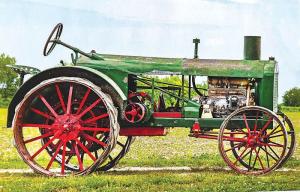
“The tractor was built in 1917 and must’ve been used lightly because the unusual friction drive didn’t show much sign of wear,” Jansen says. “It had been stored for 20 years when Jason bought it. After a little coaxing, it started and ran just fine.”
The Elgin was a rare find for Jansen, and he enjoys sharing its history.
Created by the Waite Tractor Company in 1913, the Elgin originally used engines from the Waukesha Motor Company in Wisconsin. Waite contracted with at least three businesses to build the tractor. Those didn’t pan out, and the company relocated to Elgin, Ill., and reorganized as the Elgin Tractor Corporation. A 4-cyl. Buda engine replaced the Waukesha engine. Unlike other tractors that frequently stripped drive gears, Elgin claimed their tractor would never have that problem. It was a true statement because the Elgin didn’t have any gears.
Jansen explains that the Elgin has a disc-type friction transmission, which was patented in 1904 by John W. Lambert. This design was used in trucks, fire engines and farm tractors. Power from the engine was transferred to a small “slave” disc, which then moved through a shaft to a spoked wheel inside the rear steel wheels. Jansen points out that the design wasn’t effective because the mating surface of the friction wheel was barely 2 in. Under difficult pulling conditions, the drive didn’t hold, and the rear wheels wouldn’t turn.
Despite that major flaw, the Elgin company continued to boast that it was the best tractor ever invented. Soon, however, the company moved from Elgin to Ohio, where the owners once again made bold claims. They supposedly sold $200,000 worth of stock and promised 1,000 jobs. However, only 50 employees ended up building tractors, which soon had a Rutenber Motor Co. engine. In early 1919, it was upgraded to an Erd Motor Co. engine and renamed the 12-25.
Apparently operating on smoke and mirrors, the company announced in May 1919 that prevailing economic conditions would force it to shut down. In October 1919, its entire inventory, which it valued at over $100,000, sold for around $40,000.
Jansen says that although Elgin’s boisterous claims, ineffective production, and poor sales doomed the company, he’s glad to own the only 9-18 remaining. He mentions the engine still runs, and the tractor attracts a lot of attention at parades and shows.
The person Habing bought it from had installed rubber treads on all its wheels to make it easier to drive on pavement. Repainted at some point, the metal now shows extensive weathering. Jansen says he might restore it cosmetically, and he’ll definitely keep the tractor’s original operator instructions label, located on the inside of the wooden tool storage compartment.
Contact: FARM SHOW Followup, Karl Jansen, Jansen Bros. Garage, 204 N. Main St., Sigel, Ill. 62462 (www.jansenbrosgarage.com).
Click here to download page story appeared in.
Click here to read entire issue
To read the rest of this story, download this issue below or click here to register with your account number.