2026 - Volume #50, Issue #4, Page #28
[ Sample Stories From This Issue | List of All Stories In This Issue | Print this story
| Read this issue]
They’re Transforming Farm Waste Into Drinkable Water
 |

“I decided to create a cleaning service for large water users like wineries, orchard growers and dairy farms,” Shaw says. “I thought if I could make it technologically possible and financially viable to clean wastewater, most farmers and growers would be interested.”
The result, Revida Water, takes a comprehensive approach.
“Think of water treatment in three buckets,” explains founder Shaw.
First, the process removes floating and sinking contaminants, including oils, fats, grease, rocks and wood. Second, beneficial bacteria are introduced to break down dissolved contaminants. Third, the water passes through progressively finer filters.
While the tools may differ across industries such as wine or dairy, Shaw notes, “Generally speaking, the process remains the same. Dairies, wine or tomatoes, it doesn’t really matter when it comes to cleaning it.”
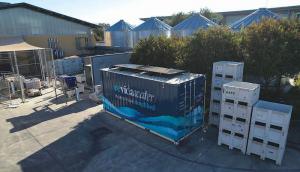
Revida’s innovation lies in its containerized infrastructure. Systems arrive at farms or wineries in 20 or 40-ft containers, ready to connect to dirty and clean-water plumbing.
“Think of us as a box, literally and figuratively, where dirty water goes in and clean water comes out,” Shaw says. “We build the box at the factory, install it at the farm, maintain it, service it, and the end user never buys the box or even worries about what’s in it. They simply buy the outcome.”
These modular systems can be customized by size and operated in sequence or in parallel, making them easy to transport, install and scale. The internal technology combines chemical treatment, microbial digestion and filtration, tailored to each site’s specific needs and volume. Units can be up and running in mere hours.
Efficiency is a constant pursuit. Revida’s deployment at UC Davis is 100% off-grid, powered by solar panels for the smaller 20-ft unit. The backup is a standard 110-volt wall outlet. Customized systems can handle anywhere from 1,000 gal a day, needed for bacteria to thrive, to over a million gallons, making them ideal for large dairies with thousands of cows.
Only a small amount of water is lost during the cleaning process as the solids drop out, usually less than 10%. The rate of loss depends on how clean the operation wants it to be when finished. From irrigation to wash water, misting or even drinking water, Revida’s systems can deliver it to the required standard.
“Even cleaning to drinking water that meets EPA standards should be able to realize 8 out of 10 gal put in. We’re the first company in the world to make the claim of commercially turning cow manure wastewater to validated drinking water.”
Shaw doesn’t just claim these results; he demonstrates them.
“I’ll drink the water, and truthfully, it’s too clean,” he says. “EPA drinking standards are quite different than on-farm animal drinking water. We’re investigating making it ‘a little less clean but safe for animals to drink.’”
California, with over 250 anaerobic digesters on dairy farms, faces significant wastewater challenges after methane capture.
“It’s a very catchy and almost too good to be true statement to say I drank cleaned water from anaerobic digesters. To make that claim, we had to make the technology happen, but there’s still a trust deficit. We’ll show interested customers what our system can do. After demonstrating, I usually drink the water, and the disbelief goes away. Then we start talking commercialization,” Shaw says.
Although Revida Water’s service is available nationwide, most installations are in California, with pilots and systems operating at sites like UC Davis.
“We didn’t reinvent this. In the past, tech A didn’t talk to tech B, and tech C didn’t talk to either. We’ve worked on that. Then we made it seamless and easy for the farmer to adopt as a no-brainer.”
Revida Water doesn’t sell its California-built systems outright. Instead, it charges by the gallon.
“Farmers give us between x and y quality water, and we promise that our treatment system will give them between a and b back. Based on that, we charge per gallon, with our target price in the cents.”
Shaw urges interested parties to contact Revida Water directly to learn more details.
Contact: FARM SHOW Followup, Revida Water, Napa/Stockton, Calif. (ph 707-247-8080; hello@revidawater.com; www.revidawater.com).
Click here to download page story appeared in.

Click here to read entire issue
To read the rest of this story, download this issue below or click here to register with your account number.