Overlooked Inventor Helped Shape Ag Equipment
 ✖  |
In the annals of early farm equipment inventors, top-of-mind names are typically Cyrus McCormick, Eli Whitney, John Deere, Charles Hart and Charles Parr, to name a few. Rarely is the name Edward Huber included in this group. History shows he definitely should be.
In 1865, Huber moved to Marion, Ohio, to manufacture a revolving hay rake of his own design, using wood from the area’s abundant ash and hickory trees. Over the next 15 years, his company built more than 200,000 of those rakes. Farmers who used them said the rake could do in 3 hr what had previously taken three men 3 days to accomplish.
Huber was named on and helped patent more than 100 other inventions. These included a steam engine, a traction engine, a grain separator, and a revolving road scraper. He was also instrumental in developing the Marion Steam Shovel Company, founded in 1865. Equipment built by that company has helped construct the Hoover Dam and the Panama Canal and has been used to extract valuable materials from open-pit mines around the world.
Considered Marion’s “Father of Industry,” Huber first adapted a gasoline engine to a steam tractor chassis in 1898. The design incorporated a traction engine frame, transmission and steering system. A Van Duzen gas engine provided the power. Huber built 30 of those tractors, each specifically designed to power Huber threshing machines.
From 1911 to 1916, his company built 24, 27 and 33-hp models with improved ignition and carburetors. These were called the “Farmer’s Tractor,” with the driver seated in the front. The tractor used evaporative cooling rather than a radiator.
Newer models included the Light Four 12-25, the Super Four 15-30 with a 4-cyl. Midwest engine, and the Master Four 20-40 with a 4-cyl. Hinckley engine. In 1936, a 2 or 3-plow Huber Model B with a Buda engine was produced in standard-tread orchard versions and in a small grader model.
When production of farm tractors was discontinued, the BG was renamed the Maintainer. Versatile and equipped with many tools, it served as a road grader, a road sweeper and a bulldozer. It also carried a sickle-bar roadside mower, a scarifier and a leveler, and offered a mounted loader option. Huber discontinued production when its parent company closed in 1984.
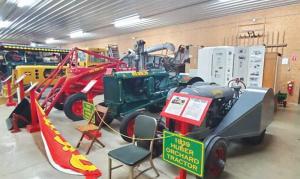
Some of the 14,000 tractors the company built are still in collectors’ hands, and Huber’s legacy of invention is preserved at the Huber Machinery Museum in Marion, Ohio. The cornerstone of the original Huber plant is on display at the Huber Museum. Also on display are several Marion Steam Shovels, the “shoe” from a crawler/transporter that moved rockets to the Cape Canaveral launch pad, and several tractors. The museum is open Saturdays from March through November, 1 to 4 p.m.
Contact: FARM SHOW Followup, Huber Machinery Museum, 220 E. Fairground St., Marion, Ohio 43301 (ph 740-387-9233; hubermuseum@gmail.com; Facebook: Huber Machinery Museum).

Click here to read entire issue
Overlooked Inventor Helped Shape Ag Equipment
In the annals of early farm equipment inventors, top-of-mind names are typically Cyrus McCormick, Eli Whitney, John Deere, Charles Hart and Charles Parr, to name a few. Rarely is the name Edward Huber included in this group. History shows he definitely should be.
In 1865, Huber moved to Marion, Ohio, to manufacture a revolving hay rake of his own design, using wood from the area’s abundant ash and hickory trees. Over the next 15 years, his company built more than 200,000 of those rakes. Farmers who used them said the rake could do in 3 hr what had previously taken three men 3 days to accomplish.
Huber was named on and helped patent more than 100 other inventions. These included a steam engine, a traction engine, a grain separator, and a revolving road scraper. He was also instrumental in developing the Marion Steam Shovel Company, founded in 1865. Equipment built by that company has helped construct the Hoover Dam and the Panama Canal and has been used to extract valuable materials from open-pit mines around the world.
Considered Marion’s “Father of Industry,” Huber first adapted a gasoline engine to a steam tractor chassis in 1898. The design incorporated a traction engine frame, transmission and steering system. A Van Duzen gas engine provided the power. Huber built 30 of those tractors, each specifically designed to power Huber threshing machines.
From 1911 to 1916, his company built 24, 27 and 33-hp models with improved ignition and carburetors. These were called the “Farmer’s Tractor,” with the driver seated in the front. The tractor used evaporative cooling rather than a radiator.
Newer models included the Light Four 12-25, the Super Four 15-30 with a 4-cyl. Midwest engine, and the Master Four 20-40 with a 4-cyl. Hinckley engine. In 1936, a 2 or 3-plow Huber Model B with a Buda engine was produced in standard-tread orchard versions and in a small grader model.
When production of farm tractors was discontinued, the BG was renamed the Maintainer. Versatile and equipped with many tools, it served as a road grader, a road sweeper and a bulldozer. It also carried a sickle-bar roadside mower, a scarifier and a leveler, and offered a mounted loader option. Huber discontinued production when its parent company closed in 1984.
Some of the 14,000 tractors the company built are still in collectors’ hands, and Huber’s legacy of invention is preserved at the Huber Machinery Museum in Marion, Ohio. The cornerstone of the original Huber plant is on display at the Huber Museum. Also on display are several Marion Steam Shovels, the “shoe” from a crawler/transporter that moved rockets to the Cape Canaveral launch pad, and several tractors. The museum is open Saturdays from March through November, 1 to 4 p.m.
Contact: FARM SHOW Followup, Huber Machinery Museum, 220 E. Fairground St., Marion, Ohio 43301 (ph 740-387-9233; hubermuseum@gmail.com; Facebook: Huber Machinery Museum).
To read the rest of this story, download this issue below or click
here to register with your account number.