Seaweed Research Reduces Methane Emissions In Cattle
 ✖  |
Efforts to reduce greenhouse gases have highlighted cattle because rumen microbes produce methane by fermenting feed. This process produces byproducts such as carbon dioxide and hydrogen, which methanogens convert into methane that cows expel.
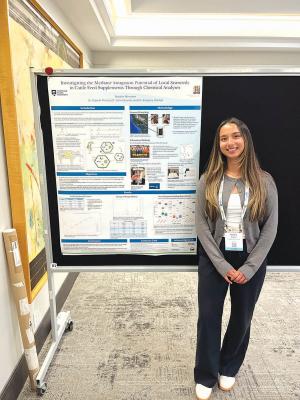
Recently, Natalie Atherton, a master’s student at Thompson Rivers University in British Columbia, conducted chemical analyses of three seaweed species abundant in British Columbia: Macrocystis pyrifera (giant kelp), Saccharina latissima (sugar kelp) and Mazzaella japonica.
“The overall goal of my research was to evaluate the potential of these three seaweed species as methane-suppressing additives in cattle feed through assessing their abundance of omega-6 and omega-3 fatty acids, phlorotannins and trace elements, including heavy metals,” Atherton explains.
She conducted her analysis in three main parts.
First, she analyzed the omega-6 to omega-3 fatty acid ratio using low-solvent, rapid proton nuclear magnetic resonance (1H NMR) spectroscopy. The analysis showed that both sugar and giant kelp have favorable omega-6/omega-3 ratios, supporting their nutritional value and methane-reducing potential. Dehydration was identified as the preferred method for seaweed sample preparation.
Phlorotannins (polyphenolic compounds abundant in brown seaweed species) were quantified using the Folin-Ciocalteu (F-C) assay, identified by 1H NMR, and trialed by capillary electrophoresis (CE). She identified the highest phlorotannin concentrations in sugar kelp; however, method variability limited the reliability of the results.
Finally, she examined trace-element concentrations, including heavy metals, in the seaweed species to assess potential toxicity risks when using the material as a livestock feed additive. Using inductively coupled plasma mass spectrometry (ICP-MS), concentrations of key elements of interest, including aluminum, arsenic, cadmium, lead and mercury, were determined and compared with Action Level (as defined by the Government of Canada) thresholds for livestock feed. All species had concentrations well below the threshold levels.
“I found that giant kelp and sugar kelp could be promising cattle feed additives for improved ruminant nutrition and potential methane reduction, as they offer good fatty acid ratios, high phlorotannin content, and low levels of trace elements, including heavy metals,” Atherton says. “These findings underscore that monitoring by site and species remains essential.”
Although limited to lab analysis, Atherton’s work contributed to the growing body of research on using seaweed in sustainable livestock feed. Her use of rapid 1H NMR analysis suggests efficient, eco-friendly methods. Further in vitro and in vivo studies are needed to confirm benefits for methane reduction and cattle health.
“Brown seaweed species (like giant kelp and sugar kelp) are locally abundant and may provide other benefits as cattle feed additives that have the potential to decrease enteric methane, as they produce bioactive secondary metabolites, including phlorotannins, that possess antioxidant, antimicrobial and anti-inflammatory properties,” Atherton says.
She believes this has led to growing interest in phlorotannins’ potential to mitigate enteric methane through alternative biochemical pathways and improved ruminant nutrition. Similarly, fatty acids (particularly long-chain polyunsaturated fatty acids) have shown potential to suppress methane emissions when added to cattle feed. These fatty acids are abundant in brown seaweed species, including sugar kelp and giant kelp.
Atherton hopes to return to this research in some capacity in the future.
Contact: FARM SHOW Followup, Natalie Atherton (natalie.atherton15@gmail.com; www.tru.ca).

Click here to read entire issue
Seaweed Research Reduces Methane Emissions In Cattle
Efforts to reduce greenhouse gases have highlighted cattle because rumen microbes produce methane by fermenting feed. This process produces byproducts such as carbon dioxide and hydrogen, which methanogens convert into methane that cows expel.
Recently, Natalie Atherton, a master’s student at Thompson Rivers University in British Columbia, conducted chemical analyses of three seaweed species abundant in British Columbia: Macrocystis pyrifera (giant kelp), Saccharina latissima (sugar kelp) and Mazzaella japonica.
“The overall goal of my research was to evaluate the potential of these three seaweed species as methane-suppressing additives in cattle feed through assessing their abundance of omega-6 and omega-3 fatty acids, phlorotannins and trace elements, including heavy metals,” Atherton explains.
She conducted her analysis in three main parts.
First, she analyzed the omega-6 to omega-3 fatty acid ratio using low-solvent, rapid proton nuclear magnetic resonance (1H NMR) spectroscopy. The analysis showed that both sugar and giant kelp have favorable omega-6/omega-3 ratios, supporting their nutritional value and methane-reducing potential. Dehydration was identified as the preferred method for seaweed sample preparation.
Phlorotannins (polyphenolic compounds abundant in brown seaweed species) were quantified using the Folin-Ciocalteu (F-C) assay, identified by 1H NMR, and trialed by capillary electrophoresis (CE). She identified the highest phlorotannin concentrations in sugar kelp; however, method variability limited the reliability of the results.
Finally, she examined trace-element concentrations, including heavy metals, in the seaweed species to assess potential toxicity risks when using the material as a livestock feed additive. Using inductively coupled plasma mass spectrometry (ICP-MS), concentrations of key elements of interest, including aluminum, arsenic, cadmium, lead and mercury, were determined and compared with Action Level (as defined by the Government of Canada) thresholds for livestock feed. All species had concentrations well below the threshold levels.
“I found that giant kelp and sugar kelp could be promising cattle feed additives for improved ruminant nutrition and potential methane reduction, as they offer good fatty acid ratios, high phlorotannin content, and low levels of trace elements, including heavy metals,” Atherton says. “These findings underscore that monitoring by site and species remains essential.”
Although limited to lab analysis, Atherton’s work contributed to the growing body of research on using seaweed in sustainable livestock feed. Her use of rapid 1H NMR analysis suggests efficient, eco-friendly methods. Further in vitro and in vivo studies are needed to confirm benefits for methane reduction and cattle health.
“Brown seaweed species (like giant kelp and sugar kelp) are locally abundant and may provide other benefits as cattle feed additives that have the potential to decrease enteric methane, as they produce bioactive secondary metabolites, including phlorotannins, that possess antioxidant, antimicrobial and anti-inflammatory properties,” Atherton says.
She believes this has led to growing interest in phlorotannins’ potential to mitigate enteric methane through alternative biochemical pathways and improved ruminant nutrition. Similarly, fatty acids (particularly long-chain polyunsaturated fatty acids) have shown potential to suppress methane emissions when added to cattle feed. These fatty acids are abundant in brown seaweed species, including sugar kelp and giant kelp.
Atherton hopes to return to this research in some capacity in the future.
Contact: FARM SHOW Followup, Natalie Atherton (natalie.atherton15@gmail.com; www.tru.ca).
To read the rest of this story, download this issue below or click
here to register with your account number.