Belted Galloway Cattle Offer Better Grassfed Beef
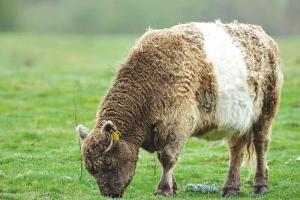 ✖  |
Belted Galloway, a Scottish heritage breed, is making a name for itself across the United States. Known for the white belts around their bodies, Galloways can be finished on grass, producing lean, flavorful meat. Better still, their hardiness and gentle temperament make “Belties” a favorite among beginning and hobby farmers worldwide.
This ancient breed originated in the rugged hill country of southwestern Scotland, a region that favors hardy livestock. Animals come in black, red or dun with a white middle, likely reflecting shared origins with the Galloway. Breeders suspect the distinctive white belt stems from an infusion of Dutch Belted blood in the 17th or 18th century. Throughout the early 1800s, the breed was standardized and optimized for efficiency on rough forage, maternal care and high-quality beef.
As a medium-sized breed, Belted Galloway cows weigh 1,000 lbs, while bulls reach 1,600 lbs. They’re considered “light grazers” that thrive on coarse grasses other breeds avoid, making them well-suited to marginal land. This means they require proportionally small amounts of feed per kilogram of body weight, making them efficient livestock.
This hardy breed tends to be highly resistant to disease and genetic problems, including pink eye, insect infestations, and foot problems. They’re naturally polled and will prevent horn growth in virtually all breeds they’re crossed with.
Their hardiness is especially pronounced in winter, as Belted Galloways are known for developing shaggy “double coats” that help them stay outdoors year-round, especially in cold, rugged climates. This fur prevents the buildup of thick subcutaneous fat, resulting in leaner cuts with higher-than-usual levels of omega-3 fatty acids. Belted Galloways have higher levels of intramuscular fat and vitamin B nutrients, leading to less marbling. Still, it’s less gamey than other grass-fed beef, and many buyers find it a better eating experience.
The U.S. received its first Belted Galloways in 1950, brought in by Harry A. Prock of Whitemarsh, Pa. Since then, imports of the breed have been limited, resulting in a relatively small national population. The Belted Galloway Society in the United States was founded soon after. Today, the breed is popular across Britain and Ireland, as well as in Australia, America, Canada and Switzerland.
Contact: FARM SHOW Followup, Belted Galloway Society (ph 608-220-1091; beltieoutreach@gmail.com; www.beltie.org).

Click here to read entire issue
Belted Galloway Cattle Offer Better Grassfed Beef
Belted Galloway, a Scottish heritage breed, is making a name for itself across the United States. Known for the white belts around their bodies, Galloways can be finished on grass, producing lean, flavorful meat. Better still, their hardiness and gentle temperament make “Belties” a favorite among beginning and hobby farmers worldwide.
This ancient breed originated in the rugged hill country of southwestern Scotland, a region that favors hardy livestock. Animals come in black, red or dun with a white middle, likely reflecting shared origins with the Galloway. Breeders suspect the distinctive white belt stems from an infusion of Dutch Belted blood in the 17th or 18th century. Throughout the early 1800s, the breed was standardized and optimized for efficiency on rough forage, maternal care and high-quality beef.
As a medium-sized breed, Belted Galloway cows weigh 1,000 lbs, while bulls reach 1,600 lbs. They’re considered “light grazers” that thrive on coarse grasses other breeds avoid, making them well-suited to marginal land. This means they require proportionally small amounts of feed per kilogram of body weight, making them efficient livestock.
This hardy breed tends to be highly resistant to disease and genetic problems, including pink eye, insect infestations, and foot problems. They’re naturally polled and will prevent horn growth in virtually all breeds they’re crossed with.
Their hardiness is especially pronounced in winter, as Belted Galloways are known for developing shaggy “double coats” that help them stay outdoors year-round, especially in cold, rugged climates. This fur prevents the buildup of thick subcutaneous fat, resulting in leaner cuts with higher-than-usual levels of omega-3 fatty acids. Belted Galloways have higher levels of intramuscular fat and vitamin B nutrients, leading to less marbling. Still, it’s less gamey than other grass-fed beef, and many buyers find it a better eating experience.
The U.S. received its first Belted Galloways in 1950, brought in by Harry A. Prock of Whitemarsh, Pa. Since then, imports of the breed have been limited, resulting in a relatively small national population. The Belted Galloway Society in the United States was founded soon after. Today, the breed is popular across Britain and Ireland, as well as in Australia, America, Canada and Switzerland.
Contact: FARM SHOW Followup, Belted Galloway Society (ph 608-220-1091; beltieoutreach@gmail.com; www.beltie.org).
To read the rest of this story, download this issue below or click
here to register with your account number.