
2026 - Volume #50, Issue #4, Page #20
[ Sample Stories From This Issue | List of All Stories In This Issue | Print this story
| Read this issue]
UK Sheep Breed Seeing Revival
 |

“The breed’s hardiness and ability to thrive on rough grazing are direct results of this long adaptation to the exposed upland landscape,” says David Butt, Chairman of the Exmoor Horn Sheep Breeders Society. In fact, the breed is so integrated into the Exmoor National Park that its grazing habits have shaped the surrounding terrain.
Exmoor Horns are considered a dual-purpose upland breed of sheep.
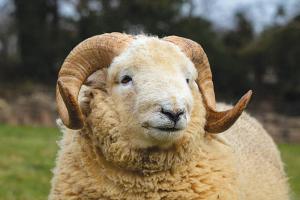
“They’re efficient converters of rough forage and are well suited to low-input systems,” says Butt. “Their distinctive horns in rams and clean, white appearance also make them visually very recognizable.”
They’re considered docile sheep that almost always make good mothers and milkers. The rams make excellent sires and are highly sought after for crossbreeding. In fact, Exmoors are regarded as a good breed for anyone new to sheep, as they tend to be self-sufficient.
Despite centuries of significance, Exmoor Horns only received official breed status in 1906. This step aimed to prevent interbreeding that could dilute the traits that made the sheep unique: a medium-length, medium-fine fleece; stocky, muscular bodies; and the ability to thrive on moors with freezing winters.
The Exmoor Horn Sheep Breeders’ Society was established in 1906 and held its first registered sale and exhibition in Winsford, Somerset, in 1907. At that time, 1,200 ewes were auctioned at an average price of 42 shillings each.
The sheep’s preferred grazing lands give the meat a distinctive flavor that once earned it the title of “the finest mutton of Victorian England.” But as modern tastes have shifted, this bold flavor is seen as less of an asset. That’s a fact the Mutton Renaissance Club of Great Britain is eager to change. They hope that increased interest in traditional mutton will help the breed make a comeback.
Spinners and crafters are also increasing the popularity of this breed by buying and using Exmoor Horn wool in their projects. Exmoor wool produces a high-quality fleece with excellent color and a good staple length, making it ideal for socks, pullovers, jackets and outerwear. Many also use it successfully for carpets and mattresses.
The push for larger farms after WWII led to more commercial breeds replacing the Exmoor Horn. While the 1908 Flock Book records listed 132 members and 25,000 pure Exmoor Horn sheep, the 2005 records showed a decline to 82 flocks and 19,000 registered ewes. Those numbers are starting to rise again as new members join and establish pedigree flocks.
“Interest has been steady, particularly among farmers looking for hardy, forage-based systems and those involved in conservation grazing,” says Butt. “The Exmoor Horn is not just a productive sheep but also an important part of the cultural and agricultural heritage of the Exmoor landscape.
“Supporting native breeds like this helps preserve genetic diversity and maintain the character of traditional British upland farming systems. For anyone farming marginal land or looking to simplify inputs while maintaining performance, the breed is well worth consideration.”
Contact: FARM SHOW Followup, Exmoor Horn Sheep Breeders Society (info@exmoorhornbreeders.co.uk; www.exmoorhornbreeders.co.uk).

Click here to read entire issue
To read the rest of this story, download this issue below or click here to register with your account number.