35,000 Antique Garden Tools And Still Collecting
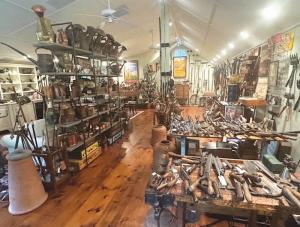 ✖  |
Mark Morrison used his career in international landscape design and construction to assemble a unique collection of antique garden tools. His collection of 35,000+ tools includes a few ice cutters and some horse-drawn equipment. However, the vast majority of his collection consists of garden tools. They range from the 16th, 17th and 18th centuries to the present day. Most are European in origin and include everything from specialty shovels to scythes, sharpeners and anvils, as well as walking canes with trowel ends for digging weeds.
“Most metal tools over the centuries were gathered up at one time or another and melted down for munitions by various governments,” says Morrison. “Mine survived. I have a lot of garden shears from the 1700s that are still sharp, and more than 600 watering cans, 200 from France alone.”
He notes that the English watering cans are more utilitarian.
“The French are copper, brass and tin, and absolutely beautiful,” says Morrison.
He relishes the sturdy nature of the old tools while acknowledging how heavy they can be.
“We started buying old tools with metal handles for my landscape construction company,” he recalls. “The workers would break the newer wooden handles.”
While he admits that some good gardening tools are still made today, you have to find specialty suppliers.
“You can buy a cheap pruning tool at Home Depot or pay from $85 to $150 for a heavy-duty, well-made one,” says Morrison. “The former may not last the season, while the well-made one can be handed down to the next generation.”
Morrison has hunted down well-made tools from Germany, China and some made by the Berbers of North Africa. However, the bulk of his tools are British, French and Dutch.
“They were the gardeners,” he says. “It’s tough to find tools from the U.S., as we didn’t have the grand gardening tradition. Most old American tools you find are junk.”
Morrison became serious about his collecting hobby about 20 years ago.
“I went to England and met some people, and got a lot of old tools you couldn’t get today,” says Morrison. “I still go to flea markets, but you can go to any number of websites online, such as eBay U.K., where there’s a chance of finding older tools.”
As his collection has grown, Morrison has become more selective about what he adds. He prefers tools with a label that includes a history or description of their use. He also prefers tools that haven’t been restored.
“I don’t want them polished or too shiny,” he says. “Many of the watering cans I’ve collected are dented from being lowered into a well for filling and then getting battered being lifted out. I try to leave things the way they are.”
Morrison has filled two buildings on his property and is working to fill a third. He’s curated his collection himself, measured tools, and had a local welder make appropriate display brackets. He looks for old tables and vintage tool chests with pull-out drawers to display some of his tools.
He has a good collection of tools designed for women and children, as well as tools displayed by type and era.
“I have a big collection of 6-in. to 4-ft long daisy grubbers with their fulcrum to pry weeds out of the ground,” says Morrison. “When I first started collecting, I was known on eBay as the ‘king of daisy grubbers.’ I also have a hedge-clipping timeline with everything from 17th-century bill hooks to sickle tools and cutting shears, to modern gas and then electric and more recent battery-powered hedge trimmers.”
While he has a special appreciation for older handcrafted tools for their balance and often beautiful handles, his collection also includes 20th-century tools. In fact, he’s designating his third building for them.
“I have a pretty good selection of Ames, True Temper and others, with racks for hand tools from the 1940s through the 1980s,” says Morrison.
Morrison notes that it’s often easier to find a tool from past centuries than from more recent years, and often from unexpected sources.
“I found a beautifully engraved trowel with a bone handle in England that was made for a man in Milwaukee, Wis.,” he says. “A lot of tools were signed or had initials carved in them.”
Morrison notes that his collection is the largest of its kind in the world. It’s generally not open to the public, but he does host small tours, and arrangements can be made to view it.
“I like to keep groups to under 15,” he says. “I’ve also offered tours to benefit causes I support.”
Morrison is unsure of the collection’s future. While he feels it’s worthy of a Smithsonian-type museum, it’s mostly European-made.
“I’d prefer it to stay together, as there’s a historical value that should be saved,” he says. “I’ll definitely be doing a book on it.”
Contact: FARM SHOW Followup, Mark K. Morrison (mkm@mkmla.com).

Click here to read entire issue
35,000 Antique Garden Tools And Still Collecting
Mark Morrison used his career in international landscape design and construction to assemble a unique collection of antique garden tools. His collection of 35,000+ tools includes a few ice cutters and some horse-drawn equipment. However, the vast majority of his collection consists of garden tools. They range from the 16th, 17th and 18th centuries to the present day. Most are European in origin and include everything from specialty shovels to scythes, sharpeners and anvils, as well as walking canes with trowel ends for digging weeds.
“Most metal tools over the centuries were gathered up at one time or another and melted down for munitions by various governments,” says Morrison. “Mine survived. I have a lot of garden shears from the 1700s that are still sharp, and more than 600 watering cans, 200 from France alone.”
He notes that the English watering cans are more utilitarian.
“The French are copper, brass and tin, and absolutely beautiful,” says Morrison.
He relishes the sturdy nature of the old tools while acknowledging how heavy they can be.
“We started buying old tools with metal handles for my landscape construction company,” he recalls. “The workers would break the newer wooden handles.”
While he admits that some good gardening tools are still made today, you have to find specialty suppliers.
“You can buy a cheap pruning tool at Home Depot or pay from $85 to $150 for a heavy-duty, well-made one,” says Morrison. “The former may not last the season, while the well-made one can be handed down to the next generation.”
Morrison has hunted down well-made tools from Germany, China and some made by the Berbers of North Africa. However, the bulk of his tools are British, French and Dutch.
“They were the gardeners,” he says. “It’s tough to find tools from the U.S., as we didn’t have the grand gardening tradition. Most old American tools you find are junk.”
Morrison became serious about his collecting hobby about 20 years ago.
“I went to England and met some people, and got a lot of old tools you couldn’t get today,” says Morrison. “I still go to flea markets, but you can go to any number of websites online, such as eBay U.K., where there’s a chance of finding older tools.”
As his collection has grown, Morrison has become more selective about what he adds. He prefers tools with a label that includes a history or description of their use. He also prefers tools that haven’t been restored.
“I don’t want them polished or too shiny,” he says. “Many of the watering cans I’ve collected are dented from being lowered into a well for filling and then getting battered being lifted out. I try to leave things the way they are.”
Morrison has filled two buildings on his property and is working to fill a third. He’s curated his collection himself, measured tools, and had a local welder make appropriate display brackets. He looks for old tables and vintage tool chests with pull-out drawers to display some of his tools.
He has a good collection of tools designed for women and children, as well as tools displayed by type and era.
“I have a big collection of 6-in. to 4-ft long daisy grubbers with their fulcrum to pry weeds out of the ground,” says Morrison. “When I first started collecting, I was known on eBay as the ‘king of daisy grubbers.’ I also have a hedge-clipping timeline with everything from 17th-century bill hooks to sickle tools and cutting shears, to modern gas and then electric and more recent battery-powered hedge trimmers.”
While he has a special appreciation for older handcrafted tools for their balance and often beautiful handles, his collection also includes 20th-century tools. In fact, he’s designating his third building for them.
“I have a pretty good selection of Ames, True Temper and others, with racks for hand tools from the 1940s through the 1980s,” says Morrison.
Morrison notes that it’s often easier to find a tool from past centuries than from more recent years, and often from unexpected sources.
“I found a beautifully engraved trowel with a bone handle in England that was made for a man in Milwaukee, Wis.,” he says. “A lot of tools were signed or had initials carved in them.”
Morrison notes that his collection is the largest of its kind in the world. It’s generally not open to the public, but he does host small tours, and arrangements can be made to view it.
“I like to keep groups to under 15,” he says. “I’ve also offered tours to benefit causes I support.”
Morrison is unsure of the collection’s future. While he feels it’s worthy of a Smithsonian-type museum, it’s mostly European-made.
“I’d prefer it to stay together, as there’s a historical value that should be saved,” he says. “I’ll definitely be doing a book on it.”
Contact: FARM SHOW Followup, Mark K. Morrison (mkm@mkmla.com).
To read the rest of this story, download this issue below or click
here to register with your account number.