2026 - Volume #50, Issue #3, Page #27
[ Sample Stories From This Issue | List of All Stories In This Issue | Print this story
| Read this issue]
AI Transforms Chemical Spraying
 |

Growing up on an 11-acre farm in Southern India, Jayaprakash came to intimately understand the inefficiencies of chemical spraying.
“Efficiency is a huge problem as most of the spray would end up on me,” he recalls, describing his experience with mango trees and backpack sprayers.
The reality of wasted chemicals and suboptimal plant coverage drove him to seek a more practical solution.
“If it turns out that the entire industry of chemical application relies on getting droplets on plants, then it’s a good idea to measure how many droplets are on a plant and control that,” Jayaprakash says.
AgZen’s mission is to optimize every droplet and granule a farmer uses, ensuring every dollar spent on chemicals is maximized. Reception from industry stakeholders, growers, chemical company partners and retailers has been overwhelmingly positive.
“Chemical application has been done with a blindfold ever since we started spraying,” Jayaprakash explains. “Our product is meant to remove that blindfold and give insight into how it’s really happening.”
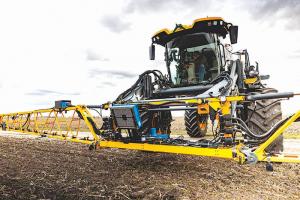
AgZen’s flagship product, RealCoverage, has already been deployed across a million acres. It’s touted as the world’s first and only system that measures and controls the number of droplets landing on plants, weeds or crops. The system is a bolt-on retrofit compatible with sprayers of any age. Installation takes only 2.5 hours and adds cameras and an AI-powered system that measures droplet coverage up to 3 ft. into the plant canopy at speeds up to 18 mph.
RealCoverage provides instant feedback on speed, gallons per acre, boom height, pressure, nozzles and adjuvants. The goal is to achieve the coverage the grower wants, prove it, and do so with minimal chemical use. Jayaprakash says this technology has enabled farmers to spray 30% to 50% less chemical while improving weed, disease and insect control.
RealCoverage works with all major chemistries, including pesticides, herbicides and fungicides, across row crops such as soybeans, cotton and corn, as well as wheat, rice, grapes, strawberries, potatoes, squash and beets.
Rather than controlling nozzles like multi-camera-equipped spot sprayers, the platform uses only two cameras, one on the boom tip and another above the wheel tracks. These areas are prone to coverage issues due to bouncing and aerodynamic disturbances. The system samples thousands of measurements along each row, providing a representative picture.
“Our units pick up the mass of how many droplets are on a leaf, so it’s not just about size. It’s assessing numbers, area covered, which ones shattered, what their lifetime was, all of it,” Jayaprakash says.
In-cab screens deliver actionable advice, recommending boom heights, speed changes, pressure adjustments, and nozzle swaps tailored to current conditions. The AI automatically starts new measurements when nozzles are changed, calculating in real time how much chemical can be safely reduced while maintaining or improving coverage.
“The beauty of machine learning and AI is that every acre we’re on, we’re learning what every parameter combination does in combination with whatever is going on with the environment,” Jayaprakash explains. “It removes the guesswork.”
Extensive testing with agricultural universities and commercial farms, including research at MIT, has shaped the learning algorithm, which adapts to diverse conditions and provides recommendations for every acre.
“We’re understanding how a farm in Australia’s data can help a farm in Iowa. It’s learning so quickly, with a million acres’ worth of data to make those recommendations, but the powerful thing is we have an extremely accurate measurement tool.”
Additionally, farmers can access their historical data through AgZen’s RealPerformance platform, available on the web, on a phone, or on a tablet. Unlike conventional tools that report only gallons per acre sprayed, RealPerformance provides detailed leaf-by-leaf measurements, empowering farmers to decide what, when and how to spray.
“The long and short of it is, we can take a farm’s chemical budget and demonstrate how to spray 30% less and still get the same or more on the plant,” Jayaprakash says. “That’s the return from a dollar-per-acre standpoint.”
For a 5,000-acre farm, the immediate savings are about $100,000 per year, with 2026 unit costs set at $97,500. The technology delivers a one-year payback and offers additional benefits, including fewer passes, elimination of resprays, and improved weed and disease control.
Contact: FARM SHOW Followup, AgZen, Greentown Labs, 444 Somerville Ave., Somerville, Mass. 02143 (info@agzen.com; www.agzen.com).
Click here to download page story appeared in.

Click here to read entire issue
To read the rest of this story, download this issue below or click here to register with your account number.