Virtual Fence No Longer Virtual
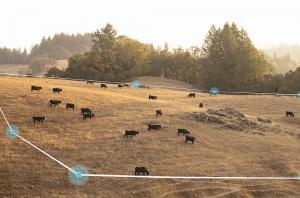 ✖  |
Halter USA’s virtual fence stands out from the herd of virtual fence providers, with over 800,000 cattle collared worldwide. It offers the usual features, such as setting up virtual paddocks, tracking animals within them, and moving them remotely. It also encourages virtual fence jumpers to return. What sets it apart is its AI component, which learns from and adapts to each animal.
“We use sound as a primary function,” says Theo Beaumont of Halter USA. “When a cow goes over the virtual fence, we use sound to turn her head around, so she walks back.”
Dual speakers provide clear left-right sound cues that indicate which direction to walk. When moving in the correct direction, the collar delivers a reassuring vibration. As with other virtual fence systems, if she doesn’t respond to the sound and vibration, she’ll receive an electronic pulse to get her attention.
“The algorithm is individualized to the cow,” adds Beaumont. “It sees every movement the cow makes and her interaction with the fence. If she’s a fence jumper, there’s a shorter grace period, and then the energy pulse will be higher. We recognize that every animal is unique, and the collar has to recognize and work with her.”
The use of virtual fencing for livestock management is rapidly growing, with systems like eShepherd (Vol. 42, No. 5), now owned by Gallagher; Nofence (Vol. 45, No. 5); Corral Technologies (Vol. 47, No. 1); and Vence, now owned by Merc Animal Health.
Collars vary from battery-powered to solar-powered and from cell phone-based to tower-based systems for areas with poor cell coverage. All use app-based control, enabling herd managers to set up virtual paddocks, monitor animal movement within paddocks, and move animals and/or virtual fences.
Halter uses a solar-powered collar built for lifelong use, featuring near-bulletproof glass. It’s weather-resistant and dust-sealed. Each collar maintains constant radio contact with a base station tower.
Nofence and Vence collars connect directly to the cloud via cellular coverage. Depending on cellular service, eShepherd offers either tower-based or cellular connectivity.
“We typically target large herd sizes in terrain that has no cell service,” says Beaumont. “We look for a spot where cell service is available for our 30-ft. tower and then network to the collars with radio.”
Most systems are designed specifically for beef, while others, like Nofence, are multi-species. Halter was initially created for the dairy industry, with collars collecting and transmitting over 6,000 data points every minute. This data included location, rumination, and health metrics to predict disease and optimal breeding times. It also reported temperature, calving recovery and more.
“Our beef system uses the same hardware but different software,” says Beaumont. “It’s stripped back to location and movement, functionality the rancher needs. One of our alerts is zero movement. In cases of predation, the sooner a rancher gets to the animal, the better the outlook for compensation.”
Halter has expanded quickly, starting in New Zealand in 2021 and later in Australia and other regions. Its recent growth in the U.S. has been equally rapid, with Beaumont attributing much of this success to staffing and training for both cattlemen and cattle.
“We have 63 people full-time in the U.S. and deeply value service to our customers,” says Beaumont. “They train the manager and the cows in a process tailored to the ranch. In the weeks before we install, we train the manager on how to use the app and work through a training plan for the two weeks post installation.”
The cattle may be easier to train than people are.
“Ranchers are blown away by how quickly their animals learn,” says Beaumont. “Adapting a herd to Halter is straightforward. The big thing is the trust the cow develops in the collar, even range cows that are seldom handled. There isn’t a cow out there that we wouldn’t collar and have total confidence that it would work effectively.”
Pricing varies between systems, with some charging by the collar and all applying some type of fee. Halter differs here as well.
“We don’t sell the collars,” says Beaumont. “Once you buy a tower base station for $4,500, the collars are yours with a lifetime warranty. We do charge a subscription fee of $72 per collar.”
Halter limits sales to herds of 100 or more. Beaumont explains that this is necessary because of the emphasis on customer service before and after installations.
“Our collars would work with smaller herds, but we couldn’t cost-effectively service our customers really well and efficiently,” he says.
Contact: FARM SHOW Followup, Halter (contact@halter.co.nz; www.halterhq.com/en-us).
Click here to download page story appeared in.
Click here to read entire issue
Virtual Fence No Longer Virtual
Halter USA’s virtual fence stands out from the herd of virtual fence providers, with over 800,000 cattle collared worldwide. It offers the usual features, such as setting up virtual paddocks, tracking animals within them, and moving them remotely. It also encourages virtual fence jumpers to return. What sets it apart is its AI component, which learns from and adapts to each animal.
“We use sound as a primary function,” says Theo Beaumont of Halter USA. “When a cow goes over the virtual fence, we use sound to turn her head around, so she walks back.”
Dual speakers provide clear left-right sound cues that indicate which direction to walk. When moving in the correct direction, the collar delivers a reassuring vibration. As with other virtual fence systems, if she doesn’t respond to the sound and vibration, she’ll receive an electronic pulse to get her attention.
“The algorithm is individualized to the cow,” adds Beaumont. “It sees every movement the cow makes and her interaction with the fence. If she’s a fence jumper, there’s a shorter grace period, and then the energy pulse will be higher. We recognize that every animal is unique, and the collar has to recognize and work with her.”
The use of virtual fencing for livestock management is rapidly growing, with systems like eShepherd (Vol. 42, No. 5), now owned by Gallagher; Nofence (Vol. 45, No. 5); Corral Technologies (Vol. 47, No. 1); and Vence, now owned by Merc Animal Health.
Collars vary from battery-powered to solar-powered and from cell phone-based to tower-based systems for areas with poor cell coverage. All use app-based control, enabling herd managers to set up virtual paddocks, monitor animal movement within paddocks, and move animals and/or virtual fences.
Halter uses a solar-powered collar built for lifelong use, featuring near-bulletproof glass. It’s weather-resistant and dust-sealed. Each collar maintains constant radio contact with a base station tower.
Nofence and Vence collars connect directly to the cloud via cellular coverage. Depending on cellular service, eShepherd offers either tower-based or cellular connectivity.
“We typically target large herd sizes in terrain that has no cell service,” says Beaumont. “We look for a spot where cell service is available for our 30-ft. tower and then network to the collars with radio.”
Most systems are designed specifically for beef, while others, like Nofence, are multi-species. Halter was initially created for the dairy industry, with collars collecting and transmitting over 6,000 data points every minute. This data included location, rumination, and health metrics to predict disease and optimal breeding times. It also reported temperature, calving recovery and more.
“Our beef system uses the same hardware but different software,” says Beaumont. “It’s stripped back to location and movement, functionality the rancher needs. One of our alerts is zero movement. In cases of predation, the sooner a rancher gets to the animal, the better the outlook for compensation.”
Halter has expanded quickly, starting in New Zealand in 2021 and later in Australia and other regions. Its recent growth in the U.S. has been equally rapid, with Beaumont attributing much of this success to staffing and training for both cattlemen and cattle.
“We have 63 people full-time in the U.S. and deeply value service to our customers,” says Beaumont. “They train the manager and the cows in a process tailored to the ranch. In the weeks before we install, we train the manager on how to use the app and work through a training plan for the two weeks post installation.”
The cattle may be easier to train than people are.
“Ranchers are blown away by how quickly their animals learn,” says Beaumont. “Adapting a herd to Halter is straightforward. The big thing is the trust the cow develops in the collar, even range cows that are seldom handled. There isn’t a cow out there that we wouldn’t collar and have total confidence that it would work effectively.”
Pricing varies between systems, with some charging by the collar and all applying some type of fee. Halter differs here as well.
“We don’t sell the collars,” says Beaumont. “Once you buy a tower base station for $4,500, the collars are yours with a lifetime warranty. We do charge a subscription fee of $72 per collar.”
Halter limits sales to herds of 100 or more. Beaumont explains that this is necessary because of the emphasis on customer service before and after installations.
“Our collars would work with smaller herds, but we couldn’t cost-effectively service our customers really well and efficiently,” he says.
Contact: FARM SHOW Followup, Halter (contact@halter.co.nz; www.halterhq.com/en-us).
To read the rest of this story, download this issue below or click
here to register with your account number.