2026 - Volume #50, Issue #3, Page #18
[ Sample Stories From This Issue | List of All Stories In This Issue | Print this story
| Read this issue]
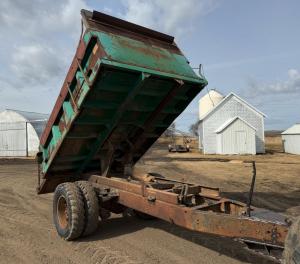
Dump Truck Repurposed Into Dump Trailer
 |
 |

“I took the cab and motor off and verified the broken crankshaft,” says Roger Gutschmidt. “There was nothing of value in the cab, but I saved the hood and the radio and gave the doors to a friend who said he could use them.”
With the truck stripped down, Gutschmidt noted that it had a double-walled frame.
“I’d never seen one before, but knew they were designed for heavy loads,” he says. “I decided to turn it into a dump trailer that I could hitch to a tractor and use around the farm.”
He started by cutting off the front end and suspension. Gutschmidt found that bending the remaining frame to make a hitch was easier than expected. He made pie-shaped cuts in the frame rails at the points where he wanted them to bend.
“I put a chain around each rail and used a load binder with a pipe to pull them together,” says Gutschmidt. “When I got the two within 18 in. of each other, I put a 1/2-in. ready rod through two holes in the frame rails so they wouldn’t spring back when I reset the load binder.”
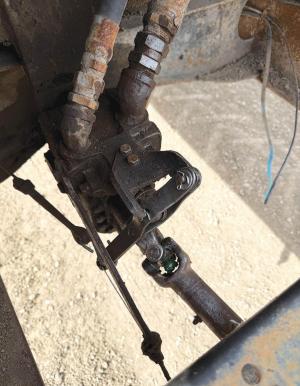
He stopped bending the rails when they were 6 in. apart, leaving a gap for the PTO shaft that powered the hydraulic pump. Gutschmidt was surprised to find there was no reservoir.
“I could’ve used the tractor hydraulics for the hoist, but that might have contaminated it with old oil in the ram,” says Gutschmidt. “Plus, the old hydraulic ram seals might not have the strength to handle the tractor hydraulics.”
Gutschmidt knew the pump didn’t take that much power; in fact, he could turn it with an electric drill. When he first connected the shaft to his tractor, the pump didn’t work.
“I discovered the pump had two stub shafts sticking out,” says Gutschmidt. “One turned clockwise and the other counterclockwise, so I was able to match the tractor’s PTO.”
The frame rails were about 30 in. high, compared with the 18-in. tractor drawbar. To keep the trailer level, Gutschmidt lowered the hitch from the frame rails by using 4 by 6-in., 1/2-in. wall rectangular tubing. This lowered the hitch height and also served as a spacer between the frame rails. He used 1/2-in. steel plate to gusset the top of the hitch and, to make a clevis hitch, welded it under the rectangular tubing. He also welded a 1/4-in. steel plate across the end of the frame rails, with a hole for the PTO shaft.
“I mounted a handle on the top gusset plate to activate the hoist,” says Gutschmidt. “Later, I added a cable to the cab.”
The cable cost $100. It was one of the few expenses in the build, aside from welding and cutting supplies.
“I didn’t have much money in it, just scrap iron I had sitting around,” says Gutschmidt. “I built it to sell and have it listed online for $3,500.”
Contact: FARM SHOW Followup, Roger Gutschmidt, Gutschmidt Manufacturing, 202 Elm St. E., Box 311, Gackle, N.D. 58442 (ph 701-269-0537).
Click here to download page story appeared in.

Click here to read entire issue
To read the rest of this story, download this issue below or click here to register with your account number.