2025 - Volume #49, Issue #6, Page #26
[ Sample Stories From This Issue | List of All Stories In This Issue | Print this story
| Read this issue]
Hobbyist Turns Craft Into A Business
 |

“Naturally, I bought it because it seemed like a really good deal,” Yonkovich says with a grin. “Turns out—not a play on words—it stayed in a box at least a few years until I retired.”
The day arrived when Yonkovich decided to learn how the lathe worked, so he ordered some mid-quality turning tools and started turning scrap wood into what resembled a soft drink bottle. He turned another piece into a vase shape, drilled a hole in the center, and covered it with varnish.
“My wife Nadine was courteous,” Yonkovich says, “not overly impressed, but she thought I had potential. That was my impetus to continue. I took a deep dive into online videos and advice sites, learned new techniques, and applied them to my wood. Years later, I’m still at it, producing beautiful items from different woods whose grains and colors are exposed by my lathe tools.”
Yonkovich says he soon realized that, in his part of Montana, the only wood available was pine and fir, “basically what I used as firewood. My other option was old fence posts that had nice grain, plus a lot of insect holes. Some of the items I made actually had character, and I even sold a few.”
Soon, he came upon a downed Quaking Aspen, which led him to craft hollow forms and unique vessels with the beauty of natural, decayed wood.
“It took me years to produce consistently nice work with help from being a remote member of a wood turning club in Great Falls. I also had experience creating a show car finish on an old Thunderbird, which transferred nicely to woodworking.”
Yonkovich says producing hollow vessels can be very challenging “because I’m basically sticking a sharp tool into a 1-in. hole spinning at 1,000 rpm. Occasionally, things don’t turn out the way I expect. When they do, I can add wood-burned and painted designs, animals, plants, flowers and birds to the outsides. If the wood has unique knots, occlusions, or unique grain configurations, I try to magnify those qualities.”
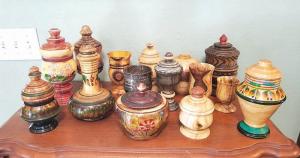
With his designs gaining more approval from his wife and producing less scrap for firewood, Yonkovich says his work has actually appealed to others. He has become skilled at turning flowers, gnomes, Christmas ornaments, unique snowmen, necklace medallions, goblets, urns and lamps. He’s also made heirloom-quality kaleidoscopes with first-surface mirrors, some featuring a rotating object lens.
Yonkovich says that although it may seem that wood turning is quick and fast because a machine is used, the opposite is true. Many of his items take several days because they require sanding, creating artwork, revisions on the lathe, unique lids, and finishes.
“At any stage, if something unexpected happens, it’s just firewood,” he says matter-of-factly.
For 11 years, Yonkovich has honed his skills on spherical surfaces to an artisan level. He’s received many compliments on his designs and sold more than 500 items. Using various woods, including some that have decayed, showcases the natural beauty of grains and color.
“I’ve made enough to justify a more modern lathe and better tools, and that’s even made the process more enjoyable,” he adds. “My wife has also become accomplished at photographing my work and posting on Facebook those that are for sale at the gift store in our small town of Lincoln, Mont.”
Contact: FARM SHOW Followup, Dean Yonkovich, Lincoln, Mont. (yonkdy41@gmail.com).
Click here to download page story appeared in.
Click here to read entire issue
To read the rest of this story, download this issue below or click here to register with your account number.