2025 - Volume #49, Issue #6, Page #25
[ Sample Stories From This Issue | List of All Stories In This Issue | Print this story
| Read this issue]
Second Harvest Redistributes Food Across Canada
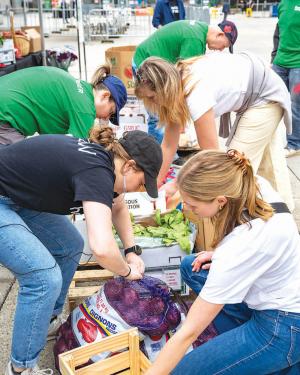 |

“The organization began in Toronto in 1985 when two friends, Ina Andre and Joan Clayton, noticed that perfectly good food from restaurants and grocery stores was being thrown away while people in their community were going hungry,” says Maureen Kirkpatrick, Director of National Foodraising at Second Harvest. “They started picking up that food, loading it into a hatchback, and delivering it to local nonprofits.”
Today, the organization is based in Etobicoke, Ontario, and operates in every Canadian province and territory.
“In 2024, we rescued and redistributed 87.1 million lbs. of surplus food, supporting more than 6.5 million people across Canada,” Kirkpatrick says. “We’re partnering with more farms every year, which means we can rescue more fresh, high-quality food right at the source.”
Canada discards enough food for 17 million people every year. Meanwhile, the country has experienced a 90% increase in food bank visits since 2019, driven by rising inflation and housing costs. Second Harvest bridges the gap by acting as a logistics coordinator for community groups and organizations. Farms, bakeries, grocery stores, and even restaurants contact the charity through its innovative app when they have surplus food. It then connects donors with recipients, ensuring smooth and efficient redistribution.
Second Harvest focuses on nutrient-rich, perishable food donations. In 2024, 43% of rescued food was fresh produce, 12% was dairy and dairy alternatives, 8.7% was meat, legumes and alternatives, and 11% was bread and grains. Still, Kirkpatrick notes that most food waste occurs before it even reaches the grocery store.
“There are losses during farming, storage and processing. Together, they account for 50% of all food waste. Farmers work hard to grow good food. When there’s surplus left in the field or in storage, it shouldn’t go to waste.”
The organization accepts donations of all sizes—ranging from tractor-trailers to individual trays. Donors can use the app to specify when and what food they have available to donate. The Second Harvest team will pick up the food and find a non-profit, food bank, or other community group that can use it. It accepts nearly anything that humans can eat, with a few safety exceptions. This includes food from people’s homes, food that was plated or served (including salad bars), packaged food with broken seals, sushi, and prepared foods that have been in a temperature danger zone for two hours.
Second Harvest meets each farm’s specific needs by coordinating logistics, arranging free pick-ups, and sourcing totes, pallets and other materials.
“Whenever possible, we strive to keep donations local so the food you grow can feed people right in your community,” Kirkpatrick says.
Farmers will receive a donation receipt for eligible contributions and can claim a tax credit based on the donation’s fair market value.
“It’s an easy, practical way to reduce waste, recover some costs, and help nourish communities across Canada. Farmers are lifelines for communities and essential environmental stewards. Their hard work sustains people, protects the environment, and strengthens the economy.”
To confirm whether Second Harvest operates in your area, contact the organization.
“While we’ve been able to rescue and redistribute so much of this good food to communities across the country, there’s still so much that could be done,” Kirkpatrick says. “Only 3.3% of surplus edible food is being rescued in Canada.”
Contact: FARM SHOW Followup, Second Harvest, 120 The East Mall, Etobicoke, Ontario, Canada M8Z 5V5 (ph 416-408-2594 or 833-639-2616; email@secondharvest.ca; www.secondharvest.ca).
Click here to download page story appeared in.
Click here to read entire issue
To read the rest of this story, download this issue below or click here to register with your account number.