Flowering Tulip Poplar Trees Are Fast Growers
 ✖  |
Tree names can be misleading. Take the tulip poplar, which is neither related to the tulip nor the poplar. Instead, these magnificent trees belong to the magnolia family and got their name from their flower-shaped leaves, which turn a sunny yellow in the fall.
The Liriodendron tulipifera, also called the tulip tree, American tulip tree, whitewood, fiddle-tree, and yellow poplar, is native to the Eastern U.S. and ranges from New England to Louisiana and Florida.
Tulip poplars are known for their rapid growth. They can grow over 100 ft., making them one of the tallest North American hardwoods and a prime lightning target during storms. Although the tree has a lifespan of more than two centuries, it can add 2 ft. to its height each year.
The tree is easily identified by its straight trunk covered in strips of light gray, furrowed bark. Tulip poplar wood is fine-grained and versatile, suitable for cabinetry, furniture, and general construction. The straight, large trunks were used by Native Americans for dugout canoes and by pioneers for building houses and barns. Today, the wood remains a popular choice for cabinetry.
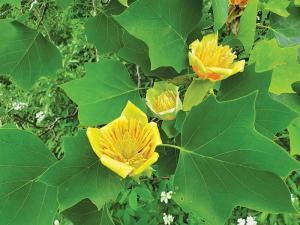
Despite the floral-inspired name, you won’t see blooms on tulip poplars until they’re 15 years old. In fact, it’s rare to spot them at all, as the trunks can grow 50 ft. before they develop branches. The 4-in. yellow and green flowers open gradually over several weeks in early summer. They emit a strong fragrance and produce plenty of nectar, which is popular with pollinators, including hummingbirds, butterflies, moths, beetles and bees.
Once the petals fall to the ground, the tree produces a cone-shaped fruit that’s a favorite among birds and other animals. One tree can produce hundreds of cones and nearly 50,000 seeds. This is significant because the germination rate is notoriously low, sometimes as low as 1.5%. Nevertheless, tulip poplar seeds remain viable for four to seven years, and the seedlings can quickly colonize open, disturbed areas.
Although you’re most likely to find tulip poplars in natural areas, these trees also make a beautiful landscaping choice. In the fall, they turn a stunning gold. Just be sure to consider their space requirements so you won’t be surprised if a towering tree develops within a few decades.
Click here to download page story appeared in.
Click here to read entire issue
Flowering Tulip Poplar Trees Are Fast Growers
Tree names can be misleading. Take the tulip poplar, which is neither related to the tulip nor the poplar. Instead, these magnificent trees belong to the magnolia family and got their name from their flower-shaped leaves, which turn a sunny yellow in the fall.
The Liriodendron tulipifera, also called the tulip tree, American tulip tree, whitewood, fiddle-tree, and yellow poplar, is native to the Eastern U.S. and ranges from New England to Louisiana and Florida.
Tulip poplars are known for their rapid growth. They can grow over 100 ft., making them one of the tallest North American hardwoods and a prime lightning target during storms. Although the tree has a lifespan of more than two centuries, it can add 2 ft. to its height each year.
The tree is easily identified by its straight trunk covered in strips of light gray, furrowed bark. Tulip poplar wood is fine-grained and versatile, suitable for cabinetry, furniture, and general construction. The straight, large trunks were used by Native Americans for dugout canoes and by pioneers for building houses and barns. Today, the wood remains a popular choice for cabinetry.
Despite the floral-inspired name, you won’t see blooms on tulip poplars until they’re 15 years old. In fact, it’s rare to spot them at all, as the trunks can grow 50 ft. before they develop branches. The 4-in. yellow and green flowers open gradually over several weeks in early summer. They emit a strong fragrance and produce plenty of nectar, which is popular with pollinators, including hummingbirds, butterflies, moths, beetles and bees.
Once the petals fall to the ground, the tree produces a cone-shaped fruit that’s a favorite among birds and other animals. One tree can produce hundreds of cones and nearly 50,000 seeds. This is significant because the germination rate is notoriously low, sometimes as low as 1.5%. Nevertheless, tulip poplar seeds remain viable for four to seven years, and the seedlings can quickly colonize open, disturbed areas.
Although you’re most likely to find tulip poplars in natural areas, these trees also make a beautiful landscaping choice. In the fall, they turn a stunning gold. Just be sure to consider their space requirements so you won’t be surprised if a towering tree develops within a few decades.
To read the rest of this story, download this issue below or click
here to register with your account number.