
2026 - Volume #50, Issue #5, Page #03
[ Sample Stories From This Issue | List of All Stories In This Issue | Print this story
| Read this issue]
Researchers Develop ‘Self-Healing’ Plastic
 |

“One of the main challenges with composite materials is repair,” says Mohammad Naraghi of the Nanostructured Materials Lab at Texas A&M. “Some damage can be well inside the material, where it can’t be seen, but can manifest itself through catastrophic failure.”
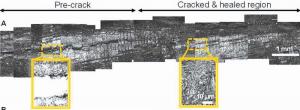
Naraghi heads a research team that includes researchers from the University of Tulsa in Oklahoma. They designed a self-healing carbon-fiber plastic composite. The plastics, called vitrimers, are reinforced with discontinuous fibers. They recover their original shape under heat treatments and outperform steel in strength.
“With a good, high-end microscope, you can look at a structure and see internal cracks that could be super small, tinier than the thickness of a human hair, nanoparticle size,” says Naraghi. “Those cracks can come together to form larger defects. Our material restores them, due in part to the material, but also due to a chemical reaction in the material.”
The material is a reality, according to Naraghi. The carbon-fiber plastic composite is called Aromatic Thermosetting Copolyester (ATSP).
“We’ve been working on it for about 5 years,” he says. “Now we’re looking for applications.”
As ATSP matures and scales up in production, Naraghi suggests it has the potential to transform commercial and consumer industries. An added benefit of self-healing is recyclability. ATSP can be melted and reused without loss of function.
Contact: FARM SHOW Followup, Mohammad Naraghi, Texas A&M, 701 H.R. Bright Building, College Station, Texas 77843 (ph 979-845-7541; Naraghi@tamu.edu).
Click here to download page story appeared in.

Click here to read entire issue
To read the rest of this story, download this issue below or click here to register with your account number.