
2026 - Volume #50, Issue #4, Page #27
[ Sample Stories From This Issue | List of All Stories In This Issue | Print this story
| Read this issue]
Kentucky Developing Warm-Season Rye
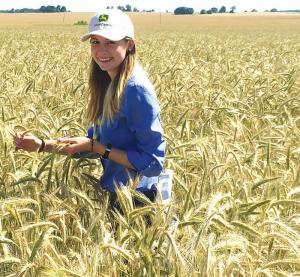 |

“Kentucky 10 is a promising alternative, and my prediction is it’ll be released soon,” says Van Sanford. “It’s open-pollinated, so growers will have the option of saving it for reseeding, selling it for use as a cover crop, or marketing it as distiller’s grain or as livestock feed.”
Van Sanford notes that both the cover crop market and distilleries offer premium prices compared with feed markets. He and his fellow University of Kentucky researchers are working with a select group of dedicated small-grain farmers to evaluate Kentucky 10 and a limited number of European hybrid rye varieties. Their goal is to develop a short-maturity, short-stature rye that stands well and resists Fusarium head blight. Van Sanford hopes rye can serve as an alternative to winter wheat in double cropping with soybeans.
“Some of the European hybrids stand well but mature late,” he says. “That’s a problem in double cropping, where every day after June 15th that you plant soybeans, you lose half a bushel in yield.”
He notes that although Kentucky 10 is taller than the European hybrids, it stands well and matures earlier. However, it typically yields about 25% less than the hybrids do.
“This was an exceptional year for small grains in the state, and we are seeing open-pollinated rye running 70 to 80 bushels per acre,” says Van Sanford.
University of Kentucky researchers continue to refine and improve it while working with several other potential varieties.
“I expect that, down the road, growers will plant both the European hybrids and open-pollinated varieties like Kentucky 10 that can be sold into the cover crop market,” says Van Sanford.
While rye acreage remains relatively small in Kentucky, a 5-year research grant aims to change that. University researchers are working with a small group of growers to fully evaluate every aspect of production and use.
“They’re diligent growers with attention to detail,” says Van Sanford. “Working with them, we hope to understand how to grow rye and identify profitability.”
One early finding is a reduced need for nitrogen compared to wheat. This is just one of the aspects of rye that the group hopes to document.
Another is the use of rye by Kentucky distillers. Craft distillers are collaborating with rye producers to develop Kentucky-grown rye spirits.
“One of our cooperators grew three different varieties of rye for sale to a distiller this year,” says Van Sanford.
Woodford Reserve Distillery committed to purchasing rye grown by four farmers for a 5-year period. The rye will be used in production and in distillery trials for sensory testing of the final distillate. Beginning in the summer of 2023, the distillery has run small trials on 10 varieties to evaluate flavor nuances that affect bourbon.
University researchers are also evaluating the use of rye in hog rations. Van Sanford describes the market as promising, with several research projects underway to better assess its potential.
Contact: FARM SHOW Followup, Prof. David Van Sanford, 327 Plant Sciences, Lexington, Ky. 40506 (ph 859-218-0770; dvs@uky.edu).

Click here to download page story appeared in.

Click here to read entire issue
To read the rest of this story, download this issue below or click here to register with your account number.