
2026 - Volume #50, Issue #4, Page #16
[ Sample Stories From This Issue | List of All Stories In This Issue | Print this story
| Read this issue]
Air Filters Made From Field Corn
 |

“Aerterra was born out of two pressing problems that hit close to home: the COVID-19 pandemic and the wildfire smoke that settled over Chicago,” says Val Demiri, a company representative. “Our co-founder, Curtis Firestone, was watching his two athletic sons push through soccer practices with masks on, the air thick with smoke, and couldn’t stop asking, ‘Is this really the best we can do?’”
Demiri, meanwhile, spent decades in the air filtration industry, watching traditional filters pile up in landfills.
“When Curtis and I met in 2023, we saw an opportunity to build something better: high-performance air filters made from renewable, plant-based materials that protect your lungs without polluting the earth.”
Today, Aerterra filters achieve this goal.
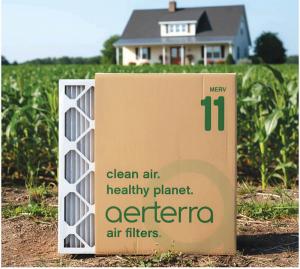
“Most filters are made from petroleum-based synthetic fibers or fiberglass,” says Demiri. “These materials are derived from fossil fuels and linger in landfills for decades. In contrast, Aerterra filters are made from polylactic acid (PLA) derived from field corn grown right here in the Midwest.”
She notes that polylactic acid is derived from the same type of field corn grown on millions of acres in the Midwest.
“Corn-based fibers are processed into high-performance filter media that capture particles down to the size of bacteria, smoke and fine allergens,” she says.
The filter’s renewable fibers are enhanced with nanofiber technology to achieve superior particle capture and airflow efficiency.
The resulting filters match or exceed the performance of conventional filters at MERV 8, 11 and 13 ratings. Each provides high-quality filtration with minimal airflow resistance throughout its lifetime. The plant-based frames are manufactured in the U.S.
“But unlike traditional filters, ours are compostable, returning to the earth rather than adding to the waste stream. This makes a meaningful difference for a product most households replace every one to three months.”
Despite these environmental benefits, Demiri is quick to clarify that using the filters is no different from standard HVAC filters.
“You simply choose your size and MERV rating and swap it in on your regular replacement schedule.”
Pricing ranges from $16 for 12-in. by 12-in. by 1-in. filters to $48 for 20-in. by 25-in. by 4-in. filters. Automatic delivery is available through a subscription that includes free shipping. Subscriptions can be paused, swapped or adjusted online in the user’s account.
“Our subscription service delivers filters on your timeline, so it’s one less thing to think about,” Demiri says. “Our ideal customer is really anyone with an HVAC system who cares about what goes into their home and where it ends up, whether that’s a family dealing with allergies, a farmer who wants American-grown products, or someone who just wants cleaner indoor air without the environmental guilt. We’ve seen a lot of interest from the agricultural community, particularly given that our filters directly expand the demand for corn.”
It’s a product that’s gaining attention.
In 2025, the National Corn Growers Association recognized Aerterra as one of the winners of its Consider Corn Challenge.
“This award validated what we’ve always believed: that American agriculture and innovation can work together to solve everyday problems,” says Demiri. “The air filter industry has not changed much in decades, and we think it’s overdue for a rethink. Every household in America replaces filters multiple times a year. That’s a lot of plastic and fiberglass heading to landfills. We started Aerterra because we believe clean air shouldn’t cost the earth, literally.”
Contact: FARM SHOW Followup, Aerterra, San Mateo, Calif. (hello@aer-terra.com; www.aer-terra.com).

Click here to read entire issue
To read the rest of this story, download this issue below or click here to register with your account number.