Homemade Heavy-Duty Leaf Cart
When Jerry Reid built his leaf cart nearly 50 years ago, he raked leaves into it and pushed it to dump them. At 89, he climbs onto his lawn tractor and lets it do the work. In the years in between, the leaf cart evolved as Reid tried different options.
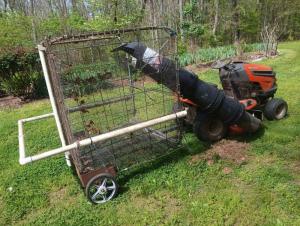
The cart began as a simple basket with a frame made from 1-in. electrical conduit. He attached cattle panels to the frame and lined them with hardware cloth. A pair of wheels salvaged from a push mower let him push it around the yard. Sheet metal pressed into the corners helped the wheels carry the load.
“The next change was to add a tongue from some salvaged aluminum square tubing, so I could pull it around the yard with my mower,” recalls Reid. “At the time, I could still pick the cart up to dump it.”
As manhandling it became more difficult, he added 2-in. PVC pipes to the sides. They allowed him to insert a handle made from 1 1/2-in. PVC pipes. This gave him leverage when unhooking it from the mower and dumping it.
A few years ago, Reid bought a new Husky lawn tractor with an attached leaf catcher. He soon modified it by adding a large tube from the side discharge to the catcher.
“I used a propane torch to bend a 5-gal. bucket into a transition from the mower-side discharge to the tubing,” says Reid. “I cut the bottoms off several more buckets, stacked them over the transition bucket, and then used 10-in. adjustable AC ducting to carry the leaves to the leaf catcher.”
With two acres of oak trees, Reid quickly realized he needed more capacity in his leaf catcher. He gave the modified Husky leaf catcher to his son-in-law and adapted it for his son-in-law’s Troy-Bilt.
Reid returned to his leaf cart and modified it to work with his new Husky. He made a new transition bucket and then built the entire leaf transfer ducting from nested 5-gal. plastic buckets.
“I attached a bucket lid to the last bucket to direct the leaves into the basket,” says Reid. “The Husky pulls the cart in line with the ducting. When it’s full, I pull it to my leaf pile, unhook it and dump.”
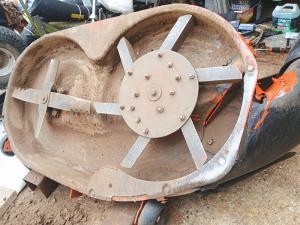
The new system worked great until it became clogged with wet leaves. Although Reid had an access hole in the transfer bucket chain, he wanted to avoid future clogs. He designed an impeller blade to replace the lawn mower blade. It is a 10-in. dia. steel plate with six angle-iron blades bolted to it, providing a 22-in. dia. cut. It shreds even wet leaves.
“I was a machinist by trade, so I knew how to balance a mower blade,” says Reid. “I laid out the bolt holes from the center, so everything was the same distance from the center. After bolting the angle iron in place, there’s a little vibration, but not enough to be a problem.”
With his cart, his mower and his impeller blade, Reid keeps his oak leaves cleared and ready for use.
“I have a 75 by 75-ft. garden, and I use shredded leaves as mulch. They keep the grass down.”
Contact: FARM SHOW Followup, Jerry Reid, 173 Henry Taylor Rd., New Market, Ala. 35761 (ph 256-519-0819).
Click here to download page story appeared in.
Click here to read entire issue
Homemade Heavy-Duty Leaf Cart
When Jerry Reid built his leaf cart nearly 50 years ago, he raked leaves into it and pushed it to dump them. At 89, he climbs onto his lawn tractor and lets it do the work. In the years in between, the leaf cart evolved as Reid tried different options.
The cart began as a simple basket with a frame made from 1-in. electrical conduit. He attached cattle panels to the frame and lined them with hardware cloth. A pair of wheels salvaged from a push mower let him push it around the yard. Sheet metal pressed into the corners helped the wheels carry the load.
“The next change was to add a tongue from some salvaged aluminum square tubing, so I could pull it around the yard with my mower,” recalls Reid. “At the time, I could still pick the cart up to dump it.”
As manhandling it became more difficult, he added 2-in. PVC pipes to the sides. They allowed him to insert a handle made from 1 1/2-in. PVC pipes. This gave him leverage when unhooking it from the mower and dumping it.
A few years ago, Reid bought a new Husky lawn tractor with an attached leaf catcher. He soon modified it by adding a large tube from the side discharge to the catcher.
“I used a propane torch to bend a 5-gal. bucket into a transition from the mower-side discharge to the tubing,” says Reid. “I cut the bottoms off several more buckets, stacked them over the transition bucket, and then used 10-in. adjustable AC ducting to carry the leaves to the leaf catcher.”
With two acres of oak trees, Reid quickly realized he needed more capacity in his leaf catcher. He gave the modified Husky leaf catcher to his son-in-law and adapted it for his son-in-law’s Troy-Bilt.
Reid returned to his leaf cart and modified it to work with his new Husky. He made a new transition bucket and then built the entire leaf transfer ducting from nested 5-gal. plastic buckets.
“I attached a bucket lid to the last bucket to direct the leaves into the basket,” says Reid. “The Husky pulls the cart in line with the ducting. When it’s full, I pull it to my leaf pile, unhook it and dump.”
The new system worked great until it became clogged with wet leaves. Although Reid had an access hole in the transfer bucket chain, he wanted to avoid future clogs. He designed an impeller blade to replace the lawn mower blade. It is a 10-in. dia. steel plate with six angle-iron blades bolted to it, providing a 22-in. dia. cut. It shreds even wet leaves.
“I was a machinist by trade, so I knew how to balance a mower blade,” says Reid. “I laid out the bolt holes from the center, so everything was the same distance from the center. After bolting the angle iron in place, there’s a little vibration, but not enough to be a problem.”
With his cart, his mower and his impeller blade, Reid keeps his oak leaves cleared and ready for use.
“I have a 75 by 75-ft. garden, and I use shredded leaves as mulch. They keep the grass down.”
Contact: FARM SHOW Followup, Jerry Reid, 173 Henry Taylor Rd., New Market, Ala. 35761 (ph 256-519-0819).
To read the rest of this story, download this issue below or click
here to register with your account number.