2026 - Volume #50, Issue #3, Page #35
[ Sample Stories From This Issue | List of All Stories In This Issue | Print this story
| Read this issue]
DIY Detents For Quick-Connect Relief
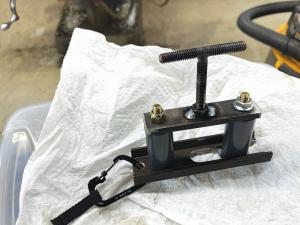 |

“I made my own with scraps I had in my shop,” says Freeman. “You can use whatever you have handy and customize the tool to your quick-connects.”
Freemen’s detent consists of two pieces of 3/8 by 1 1/2-in. wide steel bar with a T-bolt made from all-thread rod and sized to match the nipple on the quick-coupler. It also includes connecting bolts and spacers.
He drilled holes at both ends of one bar for connecting bolts and a hole in the center for the detent T-bolt.
“I welded a heavy-walled nut sized to the rod, over the center hole,” says Freeman. “I like heavy-walled nuts for this, as it’s easy to weld them in place without damaging the threads. It’s easier than tapping the hole.”
He drilled a hole in one end of the second bar and cut a slot in the other end that extends past the midpoint of the bar. The slot needed to be wide enough to slip over the threaded part of the male fixture on the hose.
“Different hose ends may require different-sized slots,” notes Freeman. “If you have multiple male sizes, only this piece will likely have to be duplicated to match each size.”
Freeman made spacers from scrap pieces of nylon block. He cut them to size, leaving space between the steel bars for the coupler head and the end of the detent T-bolt.
“Nylon blocks are easy to drill and mill to shape,” says Freeman.
He inserted a bolt through one steel bar, a coupler and the second bar. He added a washer and lock nut, tightening it just enough so the bars could still pivot.
To relieve pressure on a coupler, he slips the slot over the coupler’s threads and inserts a bolt through the hole in the bar, with the centered nut, a second spacer and the slot.
“Add a large washer and a nut to the bolt,” says Freeman. “However, before tightening the nut down, make sure the quick-connect coupler is lined up with the detent T-bolt.”
He recommends wrapping a rag around the male coupler and the detent T-bolt head while applying pressure to the nipple. He notes that it’s always messy, but the rag helps. As always with hydraulic fluid under pressure, especially if the nipple is under high pressure, avoid allowing fluid to penetrate the skin.
“I learned how easy it was to misplace the tool, so I drilled another hole at the pivoting end,” says Freeman. “I hooked a gear clip to it and hang it up when not in use.”
Contact: FARM SHOW Followup, Dale Freeman, Monroe, Va. 24574.
Click here to download page story appeared in.
Click here to read entire issue
To read the rest of this story, download this issue below or click here to register with your account number.