Nifty Chainsaw Tractor Mounts
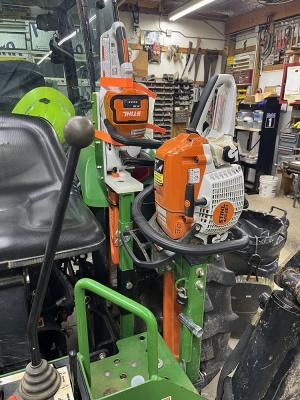 ✖  |
Nylon block chainsaw holders keep Dale Freeman’s chainsaws safe and secure. Modified receiver hitches mounted to the subframe of his tractor-mounted backhoe make chainsaws easy to access whenever needed. One hitch even serves double duty, holding a box for log chains and a cordless chainsaw.
“The receiver hitch mounts make it easy to remove the chainsaw holders and the log chain storage if I want,” says Freeman. “I often have one or the other, if not both, of my chainsaws with me, but the log chain box is always there. The holders keep them secure and out of the way when operating the backhoe, while the nylon blocks prevent damage to the chains or bars.”
Freeman’s first chainsaw holder was designed for a gas/oil chainsaw with a 20-in. bar. It had 1/4-in. thick steel plates faced with self-adhesive step rubber from Harbor Freight. One plate was welded to 2 by 2-in. square tubing. Nuts welded over holes in one plate allowed clamp-down knobbed studs to secure it to the other plate. Lock nuts on the exposed studs prevented them from vibrating out.
Freeman secured the bar cover to the plate on the tubing with two small button-head bolts.
“When I slid the chainsaw bar into the cover, I was always concerned that the nearly flat bolt heads would scratch the bar or dull the chain,” says Freeman. “Plus, with the 20-in. bar, I really had to stretch to get it into the sleeve.”
To avoid the potential problem, Freeman decided to fabricate a new chainsaw holder. Having a 55-gal. barrel filled with nylon block scraps from the company where he spent his career, he decided to use them instead of self-adhesive rubber.
“Whenever I build something, I check the scraps and often build it based on what I find,” says Freeman. “The nylon blocks are easy to slip in a vise and cut to size or mill to the desired shape. When bolting them to a surface, I recess the hole so the bolt head is below the surface.”
Freeman bolted a block of nylon to a steel plate welded to a spacer section of 2-in. tubing, then bolted it to a longer leg of tubing. The spacer prevented the chainsaw bar from rubbing against the receiver hitch for the leg.
He cut out space in the block for the bar’s plastic sleeve and epoxied it in place. He bolted a thinner section of nylon to a second plate facing the first. Again, he used knobbed studs installed through both plates to secure the sleeve and chainsaw when inserted.
Freeman mounted a 2 1/2-in. steel tube to the backhoe’s subframe as a receiver hitch for the vertical part of the chainsaw holder. Instead of using a standard receiver hitch pin, he drilled holes in each side of the receiver hitch and welded heavy-wall nuts over the holes.
“The wall nuts are larger in diameter and easier to weld in place than regular nuts without messing up the threads,” says Freeman. “Jam bolts threaded through the welded nuts eliminate vibration and noise.”
Freeman welded a short length of Schedule 40 pipe to a corner of the vertical leg to hold a chainsaw tool. He also welded a half-circle to the leg for padlocking the chainsaw in place.
“After undergoing open-heart surgery, I was unsure if I could start the gas/oil chainsaw with its pull rope, so I bought a 10-lb. battery-powered chainsaw with a 12-in. bar,” says Freeman. “I fabricated a slightly different holder for it.”
While using a similar receiver hitch design, he used more nylon blocks and made the receiver hitch serve two purposes. He started with a piece of scrap angle iron from an old electric panel. It serves as a base for a nylon plate with a slot for the chainsaw bar sleeve. The base is welded to a short length of 1 1/4-in. square tube that slips into a 1 1/2-in. tube and is secured with two D-pins. Two repurposed drawer pulls, bolted to the vertical face of the base plate, hold the bar sleeve in place.
“I bolted a piece of 1 1/2-in. tube to the subframe of the backhoe and slipped a piece of 2 by 2-in. tubing over it,” says Freeman. “The 1 1/2-in. tube from the chainsaw holder is bolted to it. The 2 by 2-in. tube serves double duty, as the base for the log chain storage box is welded to it as well.”
Freeman bent angle iron to make a frame for the heavy-duty poly battery box and used 1/4-in. thick steel plate to form a trough for the box to sit in.
“Once I had the log chain storage and the chainsaw base plate in place, I realized the cordless chainsaw was top-heavy and needed to be secured to the holder,” says Freeman. “I welded pieces of scrap metal to build up two sides of the base plate and covered them with pieces of nylon.”
He also added a 2-in. wide aluminum strip to the back side, with two strap loops attached.
“I can strap the motor in place,” says Freeman. “This eliminates any potential vibration and noise, and I can remove the chainsaw and holder in about a minute.”
Since he found the pull rope on his gas chainsaw wasn’t a problem, he rarely has the cordless one mounted. However, he reports keeping the log chain box on continuously.
Contact: FARM SHOW Followup, Dale Freeman, Monroe, Va. 24574.
Click here to download page story appeared in.
Click here to read entire issue
Nifty Chainsaw Tractor Mounts
Nylon block chainsaw holders keep Dale Freeman’s chainsaws safe and secure. Modified receiver hitches mounted to the subframe of his tractor-mounted backhoe make chainsaws easy to access whenever needed. One hitch even serves double duty, holding a box for log chains and a cordless chainsaw.
“The receiver hitch mounts make it easy to remove the chainsaw holders and the log chain storage if I want,” says Freeman. “I often have one or the other, if not both, of my chainsaws with me, but the log chain box is always there. The holders keep them secure and out of the way when operating the backhoe, while the nylon blocks prevent damage to the chains or bars.”
Freeman’s first chainsaw holder was designed for a gas/oil chainsaw with a 20-in. bar. It had 1/4-in. thick steel plates faced with self-adhesive step rubber from Harbor Freight. One plate was welded to 2 by 2-in. square tubing. Nuts welded over holes in one plate allowed clamp-down knobbed studs to secure it to the other plate. Lock nuts on the exposed studs prevented them from vibrating out.
Freeman secured the bar cover to the plate on the tubing with two small button-head bolts.
“When I slid the chainsaw bar into the cover, I was always concerned that the nearly flat bolt heads would scratch the bar or dull the chain,” says Freeman. “Plus, with the 20-in. bar, I really had to stretch to get it into the sleeve.”
To avoid the potential problem, Freeman decided to fabricate a new chainsaw holder. Having a 55-gal. barrel filled with nylon block scraps from the company where he spent his career, he decided to use them instead of self-adhesive rubber.
“Whenever I build something, I check the scraps and often build it based on what I find,” says Freeman. “The nylon blocks are easy to slip in a vise and cut to size or mill to the desired shape. When bolting them to a surface, I recess the hole so the bolt head is below the surface.”
Freeman bolted a block of nylon to a steel plate welded to a spacer section of 2-in. tubing, then bolted it to a longer leg of tubing. The spacer prevented the chainsaw bar from rubbing against the receiver hitch for the leg.
He cut out space in the block for the bar’s plastic sleeve and epoxied it in place. He bolted a thinner section of nylon to a second plate facing the first. Again, he used knobbed studs installed through both plates to secure the sleeve and chainsaw when inserted.
Freeman mounted a 2 1/2-in. steel tube to the backhoe’s subframe as a receiver hitch for the vertical part of the chainsaw holder. Instead of using a standard receiver hitch pin, he drilled holes in each side of the receiver hitch and welded heavy-wall nuts over the holes.
“The wall nuts are larger in diameter and easier to weld in place than regular nuts without messing up the threads,” says Freeman. “Jam bolts threaded through the welded nuts eliminate vibration and noise.”
Freeman welded a short length of Schedule 40 pipe to a corner of the vertical leg to hold a chainsaw tool. He also welded a half-circle to the leg for padlocking the chainsaw in place.
“After undergoing open-heart surgery, I was unsure if I could start the gas/oil chainsaw with its pull rope, so I bought a 10-lb. battery-powered chainsaw with a 12-in. bar,” says Freeman. “I fabricated a slightly different holder for it.”
While using a similar receiver hitch design, he used more nylon blocks and made the receiver hitch serve two purposes. He started with a piece of scrap angle iron from an old electric panel. It serves as a base for a nylon plate with a slot for the chainsaw bar sleeve. The base is welded to a short length of 1 1/4-in. square tube that slips into a 1 1/2-in. tube and is secured with two D-pins. Two repurposed drawer pulls, bolted to the vertical face of the base plate, hold the bar sleeve in place.
“I bolted a piece of 1 1/2-in. tube to the subframe of the backhoe and slipped a piece of 2 by 2-in. tubing over it,” says Freeman. “The 1 1/2-in. tube from the chainsaw holder is bolted to it. The 2 by 2-in. tube serves double duty, as the base for the log chain storage box is welded to it as well.”
Freeman bent angle iron to make a frame for the heavy-duty poly battery box and used 1/4-in. thick steel plate to form a trough for the box to sit in.
“Once I had the log chain storage and the chainsaw base plate in place, I realized the cordless chainsaw was top-heavy and needed to be secured to the holder,” says Freeman. “I welded pieces of scrap metal to build up two sides of the base plate and covered them with pieces of nylon.”
He also added a 2-in. wide aluminum strip to the back side, with two strap loops attached.
“I can strap the motor in place,” says Freeman. “This eliminates any potential vibration and noise, and I can remove the chainsaw and holder in about a minute.”
Since he found the pull rope on his gas chainsaw wasn’t a problem, he rarely has the cordless one mounted. However, he reports keeping the log chain box on continuously.
Contact: FARM SHOW Followup, Dale Freeman, Monroe, Va. 24574.
To read the rest of this story, download this issue below or click
here to register with your account number.