2026 - Volume #50, Issue #3, Page #28
[ Sample Stories From This Issue | List of All Stories In This Issue | Print this story
| Read this issue]
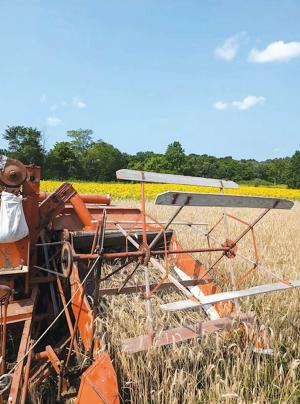
Combine Supports All-Crop Farm
 |
 |

“You can get a lot of old iron without a lot of cost,” says Suppan. “You may spend money on parts, but you’re not making payments. If you take care of it, you don’t have to spend money on anything.”
Suppan started farming the hard way, from milking on a 250-cow dairy farm at age 13 to working on a seed orchard on Vancouver Island, B.C. For 14 years, he rented small acreages before buying a 90-acre farm in 2017.
Today, he grows a wide variety of vegetables and fruit. He also grows old varieties of grain, such as Red Fife and spelt, which he mills and sells as flour (Vol. 50, No. 2). He also grows rye for sale as grain and flour, for use in cover crops, and for replanting the following year. He grows two varieties of oats, one for cover crops and hulless oats for grain sales.
To meet the demand for his flour, he had rented land some miles away and bought a “newer” combine to harvest the crop.
“I’d have to travel a busy highway pulling the All-Crop, so I bought a Gleaner E,” says Suppan. “I kept the All-Crop; it produces such a nice, clean crop.”
Suppan credits the farmers in the area for his success, especially the former owner of the farm.
“He shared all he knew about the property,” says Suppan. “Other older farmers in the area shared their knowledge with me, including a man who had operated a U-pick strawberry farm since 1978. I bought his equipment, and he mentored me.”
Suppan appreciates his older equipment for more than its cost.
“Older, smaller equipment forces you to move slower,” he says. “You can’t expand too fast.”
He’s learned the hard way about expanding too fast. At one time, he was up to 3 acres of strawberries and was doing a lot of pre-picking.
“You need a certain threshold to cover costs, and I got bigger to pay for workers,” recalls Suppan. “That added an extra level of stress, both work and financial. I realized it didn’t make a lot of sense.”
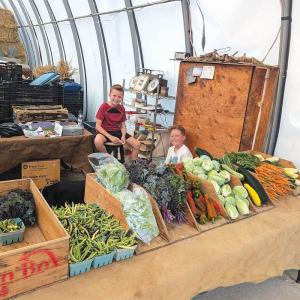
He decided to focus on U-pick because there were no other U-picks in his area. He also runs his CSA as a type of U-pick. Members come to the farm and fill their boxes at a market-style table.
“Having customers come to the farm for strawberries and for our CSA vegetables is huge for our quality of life,” says Suppan.
The farm was certified organic for about six years, but Suppan has farmed organically without certification for the past four years. He relies on crop rotation to minimize pest, weed and disease pressure.
“I’m a big fan of long rotations with cover crops in the ground for a long time,” says Suppan. “I plant oats as a nurse crop for clover in preparation for planting vegetables or strawberries. Sometimes I incorporate sunflowers with the oats and plant yellow sweet and double red clovers.”
He’s committed to regenerative agriculture but doesn’t emphasize it in his marketing. In fact, he does little marketing.
“Working with social media and our website has kept us busy. Our 2026 CSA is sold out, with a waiting list.”
Contact: FARM SHOW Followup, Fat Chance Farmstead, 3711 Hwy. 38, Harrowsmith, Ontario, Canada K0H 1V0 (ph 613-539-5569; fatchancefarmstead@gmail.com; www.fatchancefarmstead.com).
Click here to download page story appeared in.

Click here to read entire issue
To read the rest of this story, download this issue below or click here to register with your account number.