
2026 - Volume #50, Issue #3, Page #26
[ Sample Stories From This Issue | List of All Stories In This Issue | Print this story
| Read this issue]
Grass-Fed Cull Dairy Cows Produce Premium Beef
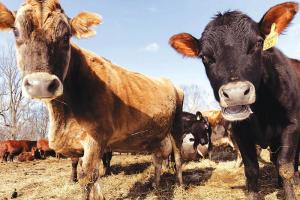 |

“Since 2023, we’ve compared our grass-fed dairy beef against two controls: grass-fed beef steers raised on the same pastures and a premium organic grain-fed beef control,” says Andrew Luzmore of Rhizome. “The dairy beef has consistently outperformed the grain-fed control on flavor and on several nutritional metrics, including beta carotene and omega-3s. Compared with the grass-fed beef steers, dairy beef has typically performed better on flavor. Nutritional profiles have been similar, aside from higher beta carotene in the dairy beef.”
Rhizome is a joint venture between Stone Barns Center for Food & Agriculture, a nonprofit farm, research and education center, and Blue Hill. Blue Hill, a privately owned restaurant at the center, leads the culinary development and evaluation of projects such as grass-fed dairy beef.
“We’re now in the fourth year of the project, and while we’re beginning to see meaningful signals in the data, there are still many variables shaping finished quality,” says Luzmore.
He lists age, breed, body condition score, forage quality and pasture management as key variables. As a result, he expects research to continue for several years. Later this year, Luzmore plans to share early findings with dairy farmers, butchers, distributors and others in the meat industry.
“Beyond that, we plan to share a practical playbook outlining best practices and management factors that appear to correlate with finished quality,” he says.
That finished quality can be exceptional. Blue Hill Chef Dan Barber has even claimed it’s better than Wagyu when done right. Luzmore notes that some cuts are best suited for steaks, others for braising, and others for processing, such as for sausages.
“Breed does appear to have a direct effect on overall quality, and for that reason, some breeds may be better suited to premium steak cuts than others,” says Luzmore. “The end result of what we’re serving at Blue Hill is incredible.”
He notes that, when it comes to the economics of finishing a cow over a 9-month period, breeds do make a difference. Holsteins, which have been intensively bred for milk production, don’t perform as well as Jerseys, Guernseys or Ayrshires.
In addition to breed, the cull cows in the project vary in age, ranging from 4 to 7 years. They’ve been diverted from a network of grass-based farms in the Northeast.
“We bring them here and study how to best finish the different breeds and ages on grass and forage, and learn how they put on weight,” says Luzmore. “We’re still proving out the methodologies.”
The goal of the project is to create a premium health food market for cull dairy cows. To do that, they have to change what people expect. Barber has described the standard for beef as tender cuts with colorless fat from young beef cattle. He and the research team at Stone Barns Center hope to broaden that standard to include dairy beef.
He responded to one request, writing, “It’s [about] giving the cow, who might not be an Angus or Wagyu or an esteemed beef cattle breed, the chance to put on fat and muscle and develop pronounced and idiosyncratic flavoring.”
Dairy beef can often be enjoyed in a number of dishes at Blue Hill. The dishes include “retired dairy cow with root-to-leaf celeriac,” “dairy cow Figatellu,” and a dish Barber calls “dog food.” It’s actually a meatloaf made from dairy-cow meat and potatoes, cut to resemble rice.
Contact: FARM SHOW Followup, Andrew Luzmore, Blue Hill at Stone Barns, 630 Bedford Rd., Pocantico Hills, N.Y. 10591 (ph 914-366-6200; info@rhizome.food; www.stonebarnscenter.org; Instagram: @rhizome.food).
Click here to download page story appeared in.

Click here to read entire issue
To read the rest of this story, download this issue below or click here to register with your account number.