
2026 - Volume #50, Issue #3, Page #25
[ Sample Stories From This Issue | List of All Stories In This Issue | Print this story
| Read this issue]
Compact E-Motor Maxes Out At 1,000 HP
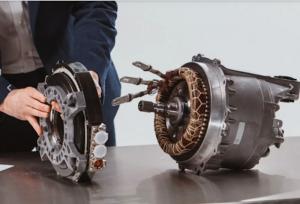 |

The novel design has previously demonstrated its ability to double the power output of conventional radial flux motors. Even better, YASA achieves this at half the weight and spatial volume for greater torque density.
To date, use has been limited to extreme, high-performance cars and racing boats, in part due to limited production. However, the combination of power and torque suggests rapid adoption potential in industrial and off-road applications. The company is actively exploring marine and military applications, as well as other uses, such as generators and pumps on superyachts.
While axial flux motors were invented by Michael Faraday in 1821, the radial flux design, which came a few years later, was easier to manufacture and offered better cooling. In 2005, Tim Woomer, a PhD student at Oxford, had fresh insights into the old design.
He realized that by removing the motor’s stator yoke and splitting it into segments, he could reduce the motor’s weight and size. It also allowed the motor to be manufactured using Soft Magnetic Composite material. At the same time, the new design would improve torque, power density, efficiency and manufacturability.
Woomer founded YASA in 2009 to develop, build and promote what he describes as a torus axial flux motor. It can deliver up to four times the torque density of radial machines. In addition, it uses less copper, iron and permanent magnets, lowering production costs and making it easier to manufacture. A sealed-for-life design simplifies maintenance.
Because axial flux motors have direct oil cooling, they can run continuously without losing peak power. As a radial flux motor is driven hard, its windings heat up, reducing available power. This feature makes axial flux motors ideal for electric vehicles.
The company opened its production facility in 2018 and became a Mercedes-Benz subsidiary in 2021. In 2025, it opened a large-scale production factory with a capacity of 25,000 units per year.
YASA is exploring an extremely lightweight, 1,000-hp design for in-wheel use. A prototype has a continuous rated output of 536 hp and a peak output of 1,005 hp. According to the company, regenerative braking with the powerful in-wheel motor has the potential to eliminate the need for rear brakes. It would also eliminate the need for driveshafts, shaving about 440 lbs. from current-generation electric vehicles.
Contact: FARM SHOW Followup, YASA Limited, 11-14 Mead Road, Oxford Pioneer Park, Yarnton, Kidlington, United Kingdom OX5 1QU (www.yasa.com).
Click here to download page story appeared in.

Click here to read entire issue
To read the rest of this story, download this issue below or click here to register with your account number.