Farmer Experiment Offers Winter Wheat Solution
 ✖  |
Jim Halford, a longtime advocate for conservation and no-till farming, has been instrumental in developing practical solutions for winter wheat growers across the Canadian Prairies. Winter wheat is typically best sown after crops such as canola, but the shift toward longer-maturing canola varieties and straight-cutting has complicated timely planting. The bottleneck is that farmers often can’t seed winter wheat because they’re still harvesting canola.
Halford’s ingenuity led him to retrofit his swather with a spray boom and a cart for water and herbicide, enabling him to apply pre-seed herbicide during canola swathing. This hands-on innovation eliminated the need for a separate pre-seed herbicide operation for winter wheat. By spraying at the same time as swathing, Halford believed farmers could control weeds and conserve soil moisture at this crucial time of year, when harvest and field work demands intersect.
What Halford accomplished wasn’t merely a smart labor-saving tactic; it streamlined timing control, one of the biggest hurdles for Prairie farmers. Spraying pre-seed herbicide during canola swathing made it easier for growers to transition to winter wheat without sacrificing efficiency.
After a local field day in Indian Head, Saskatchewan, Halford convinced Brian Beres, a research scientist with Agriculture and Agri-Food Canada, to make a side trip to Halford’s farm to view Halford’s recent swather retrofit experiment.
“From what Jim showed me, I thought he had a really good idea,” Beres says. “My first goal was to build some science around it.”
Beres took on the task and led a scientific study to expand the idea.
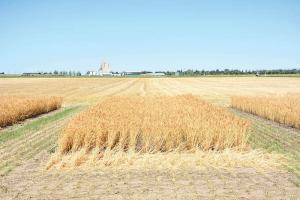
With funding in place for a winter wheat and canola sequencing study, Beres and his team adapted the technique for small-scale trials, mounting a sprayer tank directly onto a 12-ft. Versatile swather. The experiments compared swathing versus straight-cutting, simultaneous swathing and spraying, and standard pre-seed herbicide applications ahead of winter wheat planting.
“The results were every bit as good in our study as Jim got on his farm,” Beres says. “It was a cool experiment showing that the simultaneous swathing and spraying of application plots delivered slightly higher yields.”
Conducted across Lethbridge, Indian Head, Lacombe and Brandon from 2019 to 2024, the trials generated compelling data spanning 16 site-years. The research, later published in the European Journal of Agronomy, demonstrated strong weed control while helping to eliminate the need for separate fall herbicide applications.
Despite these advances, the trend in Western Canada has favored straight-cutting canola, especially in brown-soil zones, where crop heights and yields are lower.
“The trials showed that if you’re a serious winter wheat grower who straight cuts, you’ll pay a yield penalty in your winter wheat rotation,” Beres says. “We had superior yields in swathed vs. straight-cutting. Sometimes farmers adopt things like this, but operations that swath and are committed winter wheat growers should look seriously at what both Jim’s and our studies accomplished.”
Contact: FARM SHOW Followup, Agriculture and Agri-Food Canada (AAFC), Lethbridge Research and Development Centre, 5403 1st Ave. S, Lethbridge, Alberta, Canada T1J 4B1 (brian.beres@agr.gc.ca).
Click here to download page story appeared in.
Click here to read entire issue
Farmer Experiment Offers Winter Wheat Solution
Jim Halford, a longtime advocate for conservation and no-till farming, has been instrumental in developing practical solutions for winter wheat growers across the Canadian Prairies. Winter wheat is typically best sown after crops such as canola, but the shift toward longer-maturing canola varieties and straight-cutting has complicated timely planting. The bottleneck is that farmers often can’t seed winter wheat because they’re still harvesting canola.
Halford’s ingenuity led him to retrofit his swather with a spray boom and a cart for water and herbicide, enabling him to apply pre-seed herbicide during canola swathing. This hands-on innovation eliminated the need for a separate pre-seed herbicide operation for winter wheat. By spraying at the same time as swathing, Halford believed farmers could control weeds and conserve soil moisture at this crucial time of year, when harvest and field work demands intersect.
What Halford accomplished wasn’t merely a smart labor-saving tactic; it streamlined timing control, one of the biggest hurdles for Prairie farmers. Spraying pre-seed herbicide during canola swathing made it easier for growers to transition to winter wheat without sacrificing efficiency.
After a local field day in Indian Head, Saskatchewan, Halford convinced Brian Beres, a research scientist with Agriculture and Agri-Food Canada, to make a side trip to Halford’s farm to view Halford’s recent swather retrofit experiment.
“From what Jim showed me, I thought he had a really good idea,” Beres says. “My first goal was to build some science around it.”
Beres took on the task and led a scientific study to expand the idea.
With funding in place for a winter wheat and canola sequencing study, Beres and his team adapted the technique for small-scale trials, mounting a sprayer tank directly onto a 12-ft. Versatile swather. The experiments compared swathing versus straight-cutting, simultaneous swathing and spraying, and standard pre-seed herbicide applications ahead of winter wheat planting.
“The results were every bit as good in our study as Jim got on his farm,” Beres says. “It was a cool experiment showing that the simultaneous swathing and spraying of application plots delivered slightly higher yields.”
Conducted across Lethbridge, Indian Head, Lacombe and Brandon from 2019 to 2024, the trials generated compelling data spanning 16 site-years. The research, later published in the European Journal of Agronomy, demonstrated strong weed control while helping to eliminate the need for separate fall herbicide applications.
Despite these advances, the trend in Western Canada has favored straight-cutting canola, especially in brown-soil zones, where crop heights and yields are lower.
“The trials showed that if you’re a serious winter wheat grower who straight cuts, you’ll pay a yield penalty in your winter wheat rotation,” Beres says. “We had superior yields in swathed vs. straight-cutting. Sometimes farmers adopt things like this, but operations that swath and are committed winter wheat growers should look seriously at what both Jim’s and our studies accomplished.”
Contact: FARM SHOW Followup, Agriculture and Agri-Food Canada (AAFC), Lethbridge Research and Development Centre, 5403 1st Ave. S, Lethbridge, Alberta, Canada T1J 4B1 (brian.beres@agr.gc.ca).
To read the rest of this story, download this issue below or click
here to register with your account number.