2026 - Volume #50, Issue #2, Page #10
[ Sample Stories From This Issue | List of All Stories In This Issue | Print this story
| Read this issue]
Tracking Software Shows Equine Health
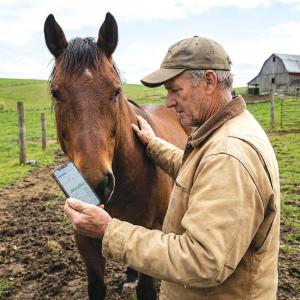 |

“GrazeStat is an equine health and feeding intelligence system built to provide horse owners with earlier, more actionable insight into daily health patterns—before subtle shifts escalate into serious concerns,” says Fintel. “It currently has five pilot prototype systems scheduled for deployment in mid-2026, with commercial rollout anticipated in late 2026 to early 2027.”
It’s an invention close to his heart. Fintel’s earliest memories are on the family farm, where intervention was necessary in the winter months to prevent newborn calves from freezing. His deep desire to help animals thrive only grew stronger in 2013 after losing a bred mare to late-gestation colic. Today, Fintel and his wife care for horses and other animals on their expansive acreage in Nebraska. Traveling for work leaves the animals unattended, and even when home, they can’t monitor the horses 24/7.
With GrazeStat, he aims to address this problem. The tracking will leverage continuous, passive monitoring at the resource zone (following additional testing and commercialization) to capture visit frequency and duration, water intake, facial pain cues, gait analysis, and behavioral changes.
Fintel clarifies that GrazeStat is not a diagnostic system. Rather, it’s a decision-support tool for determining when to call in an expert. The technology doesn’t interfere with the animals; it quietly observes and learns from their daily patterns.
Once a horse’s profile is created in the GrazeStat app, the system establishes the horse’s normal baseline over several days. App users will then receive daily health summaries, trend alerts, and shareable reports for veterinarians or caretakers. If behavior deviates from the horse’s baseline, notifications are sent via text or through the GrazeStat app.
GrazeStat pricing has not been finalized, but Fintel predicts that a $74.95/month subscription will cover up to three horses, at an annual cost of about $300 per horse.
“Preventing a single colic episode, choke event, or delayed diagnosis could offset multiple years of GrazeStat subscription costs,” Fintel says. “Emergency veterinary services easily reach the thousands. In contrast, GrazeStat can identify subtle changes in feed and water behavior before the issues escalate.”
A patent-pending accessory package will provide continued surveillance options beyond the resource zone, including when the horse is out to pasture, traveling in a trailer, or being ridden or boarded in a stall.
The device pairs well with the EZ Grazer Ultra Hay-Net Feeding system, another Fintel invention. It’s designed to keep forage elevated, contained and protected, improving feeding efficiency and horse health by helping animals follow their natural grazing instincts.
Horses will graze for 14 to 18 hrs. a day, consuming 1.5% to 2.5% of their body weight. When hay remains clean, dry and accessible, horses feed more consistently, which supports better digestive health. The EZ Grazer can slow the eating pace from 3.3 lbs. per hour to 1.9 lbs. per hour, reducing the risk of colic, promoting digestive health, and supporting better weight management.
Likewise, using the EZ Grazer with properly used hay nets can result in hay loss of less than 1%, significantly outperforming many conventional feeding methods. It also protects hay from moisture damage that can trigger mold and bacterial growth and diminish its nutritional value.
Now in the final design stages, Fintel seeks input from customers willing to pilot the GrazeStat software, which will be ready for testing in mid-2026 or early 2027. Interested parties can reach out directly.
Contact: FARM SHOW Followup, Sean Fintel, GrazeStat (info@grazestat.com; www.grazestat.com).
Click here to download page story appeared in.
Click here to read entire issue
To read the rest of this story, download this issue below or click here to register with your account number.