Advancements In Targeted Pest Management
 ✖  |
In agricultural pest management, traditional broad-spectrum pesticides that control fungi, insects and plants often harm beneficial organisms alongside target pests. As pest resistance grows and regulatory pressures mount, the need for more precise, species-specific solutions has never been greater.
Dr. Justin Pahara, an Agriculture and Agri-Food Canada Research Scientist in Lethbridge, Alberta, and his team are committed to advancing targeted pest management by developing new active ingredients that can be delivered to specific pest species.
“Our group focuses on how to get ingredients into target pests,” Dr. Pahara says. “Many studies are working on creating active ingredients, but the limitation, in our opinion, is reliably getting new active ingredients into those targets.”
While traditional pesticides rely on small molecules that aren’t easily designed to be species-specific in broad-spectrum applications, emerging technologies focus on nucleic acids such as DNA and RNA. These molecules can be engineered to target only specific species, thereby reducing collateral damage to non-target organisms.
“They’re a bit bigger and also more susceptible to environmental factors,” Dr. Pahara says. “They can quite easily break down and degrade. Unlike the biomedical realm with controlled environments, in agriculture, we spray the field, and the weather is what it is, plus there are lots of organisms floating around. We need to protect these new ingredients and ensure they reliably meet the targets.”
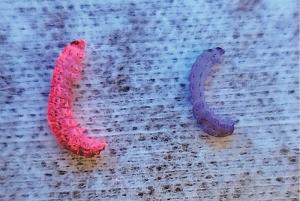
To overcome these obstacles, the team is conducting research at the Canadian Light Source (CLS) facility at the University of Saskatchewan, using nanoparticles to deliver active ingredients directly to pests. With advanced equipment, including the CLS BioXAS beamline, they’re tracking how nanosystems move, whether they adhere to body surfaces, penetrate, or accumulate within target insects. The findings are guiding the team in designing nucleic acid-based solutions that target specific tissues or cells within pests, thereby enhancing both efficacy and safety.
The research is ongoing, with experiments currently limited to laboratory settings due to regulatory permits. Specialized spray chambers and a steady supply of pest colonies, including lygus bugs, cutworms and Fusarium fungi, are advancing the work. The research spans a range of species, including kochia, and explores delivery methods for crops such as soybeans, corn and barley.
“Ultimately, our goal is to produce early prototypes and partner with commercial companies to combine these innovations into agricultural products,” Dr. Pahara says. “I believe this research is extremely important and hope others will join in focusing efforts in this area. We must address the growing tolerance of pests and find our way through evolving regulatory barriers.”
Dr. Pahara invites producers to share their concerns and collaborate to shape the future of sustainable agriculture.
Contact: FARM SHOW Followup, Dr. Justin Pahara, Agriculture and Agri-Food Canada, Lethbridge Research and Development Centre, 5403 1st Ave. S., Lethbridge, Alberta, Canada T1J 4B1 (justin.pahara@agr.gc.ca).

Click here to download page story appeared in.
Click here to read entire issue
Advancements In Targeted Pest Management
In agricultural pest management, traditional broad-spectrum pesticides that control fungi, insects and plants often harm beneficial organisms alongside target pests. As pest resistance grows and regulatory pressures mount, the need for more precise, species-specific solutions has never been greater.
Dr. Justin Pahara, an Agriculture and Agri-Food Canada Research Scientist in Lethbridge, Alberta, and his team are committed to advancing targeted pest management by developing new active ingredients that can be delivered to specific pest species.
“Our group focuses on how to get ingredients into target pests,” Dr. Pahara says. “Many studies are working on creating active ingredients, but the limitation, in our opinion, is reliably getting new active ingredients into those targets.”
While traditional pesticides rely on small molecules that aren’t easily designed to be species-specific in broad-spectrum applications, emerging technologies focus on nucleic acids such as DNA and RNA. These molecules can be engineered to target only specific species, thereby reducing collateral damage to non-target organisms.
“They’re a bit bigger and also more susceptible to environmental factors,” Dr. Pahara says. “They can quite easily break down and degrade. Unlike the biomedical realm with controlled environments, in agriculture, we spray the field, and the weather is what it is, plus there are lots of organisms floating around. We need to protect these new ingredients and ensure they reliably meet the targets.”
To overcome these obstacles, the team is conducting research at the Canadian Light Source (CLS) facility at the University of Saskatchewan, using nanoparticles to deliver active ingredients directly to pests. With advanced equipment, including the CLS BioXAS beamline, they’re tracking how nanosystems move, whether they adhere to body surfaces, penetrate, or accumulate within target insects. The findings are guiding the team in designing nucleic acid-based solutions that target specific tissues or cells within pests, thereby enhancing both efficacy and safety.
The research is ongoing, with experiments currently limited to laboratory settings due to regulatory permits. Specialized spray chambers and a steady supply of pest colonies, including lygus bugs, cutworms and Fusarium fungi, are advancing the work. The research spans a range of species, including kochia, and explores delivery methods for crops such as soybeans, corn and barley.
“Ultimately, our goal is to produce early prototypes and partner with commercial companies to combine these innovations into agricultural products,” Dr. Pahara says. “I believe this research is extremely important and hope others will join in focusing efforts in this area. We must address the growing tolerance of pests and find our way through evolving regulatory barriers.”
Dr. Pahara invites producers to share their concerns and collaborate to shape the future of sustainable agriculture.
Contact: FARM SHOW Followup, Dr. Justin Pahara, Agriculture and Agri-Food Canada, Lethbridge Research and Development Centre, 5403 1st Ave. S., Lethbridge, Alberta, Canada T1J 4B1 (justin.pahara@agr.gc.ca).
To read the rest of this story, download this issue below or click
here to register with your account number.