2025 - Volume #49, Issue #6, Page #38
[ Sample Stories From This Issue | List of All Stories In This Issue | Print this story
| Read this issue]
He Has A Long History Of ‘Painting Tractors Perfect’
 |

Collectors who’ve purchased tractors Thoennes has restored and painted say his work is “particular plus,” museum-quality from front to back, top to bottom. One customer, especially impressed with his quality work, bought a completely restored Super M-TA from him for $8,500.
“He thought long and hard about the price, but after he parked it next to others at a show, he realized his looked a lot better,” says Thoennes. I’d cleaned and painted inside the frame rails, underneath the body, under the hood and under the gas tank. I put on a new seat, a new steering wheel, a wiring harness, lights and new tires. The radiator and front end were super clean. He became a repeat customer who later bought a Super H and Cub from me.”
Thoennes grew up on a farm north of Alexandria, Minn., driving a Farmall H that his dad bought new in 1951. He hadn’t thought much about painting tractors until he and a neighbor restored and painted a 1950 Farmall A.
“He was a very particular guy,” Thoennes says, “so I learned the basics well. We took apart everything we could, sandblasted away the grit, grime and grease, then primed and painted it.”
That experience inspired Thoennes to get serious about restorations. One of his next projects was restoring his dad’s H.
“After I was done, he looked it over carefully and gave me a really nice compliment, telling me, ‘It didn’t look that nice when I bought it new.’”
Thoennes still has the H, along with a treasured picture of him and his parents beside it.
Thoennes has studied, practiced and improved his techniques on more than 50 red tractors. He’s worked on A, B, C, H, M, Super H, and Super M models. A Super M-TA, along with 300, 656 and 560 red ones, have also gone through his shop. He’s rebuilt engines on several of these, installed sleeves and pistons, ground valves, honed and polished crankshafts, and rebuilt rear ends. He removes frame rails on the smaller tractors to sandblast away grease and grit that’s inside—an important step that he says a casual observer probably wouldn’t notice if it weren’t done.
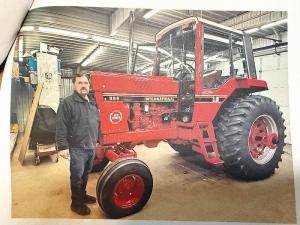
Most of his projects have involved open-station tractors, although he worked on a cab-model International 886 for nearly a year.
“The engine was in good shape, but everything else needed work,” Thoennes says. “I rebuilt the inside of the cab and operator station, installed a new seat, gauges and flooring. Rebuilding the air conditioning, radiator, brakes and electrical system were also part of the project. I removed the wheels and tires, sandblasted the rims inside and out, and sandblasted the whole tractor body before repainting it. Like others I’ve done, the tractor probably looks better now than when it came from the factory.”
Thoennes uses Case IH and Farmall factory paint, adding hardener before priming and topcoat applications. He clear coats some projects but says that step isn’t really needed if cleaning and prep work are done properly.
“The key is having everything clean, dry and free from any oil or fluids,” Thoennes says. “I never paint over existing paint because there’s always a possibility of blistering and cracking, which only gets worse over time.”
Thoennes says he wants all his projects to look really nice. His daughter, Jen, says he actually wants them to look better than perfect. He tells people who want museum-quality to keep their tractors out of a cold building. Over time, the freeze-thaw cycles and moisture will damage the paint.
Contact: FARM SHOW Followup, Dave Thoennes, 4080 Latoka Beach Rd. SW, Alexandria, Minn. 56308 (dave@gctel.net).
Click here to download page story appeared in.

Click here to read entire issue
To read the rest of this story, download this issue below or click here to register with your account number.