Robotic Weeder Serves As Teaching Aid
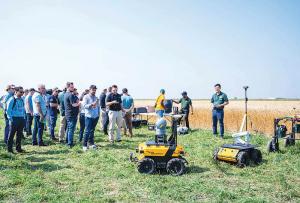 ✖  |
Agricultural engineers at North Dakota State University (NDSU) have created a robotic weeder, but it’s not available for purchase. Its purpose is to educate students and farmers about new technologies like AI, robotics and imagery that can help automate weed control.
“We’re using the robot to educate the next generation of farmers,” says Dr. Xin Sun, Agricultural and Biosystems Engineering, NDSU. “We want our students to have the opportunity to learn these technologies and bring them back to the farm.”
Sun’s research team is creating multiple prototypes for weed control in small grains, row crops and specialty crops. Essential to this work is developing algorithms to improve the robot’s efficiency and AI models to identify specific crop and weed species in the field.
“Our team has collected over 20 million images of crops and weeds in different formats of imagery data to train and test our AI models to recognize the specific crop and weed species in the field,” he said. “Our goal is to use AI to recognize the weeds and treat them automatically, chemically and mechanically, without human interaction.
“Right now, we’re proud to say we’ve established some amazing weed/crop algorithms, and currently we’re in the stage of making some final products for farmers to test the technology,” adds Sun.
One of the prototypes uses AI deep learning and machine vision for spot spraying weeds. Arjun Upadhyay, a doctoral graduate research assistant, developed it.
Other prototypes include a 3-row mechanical weeding system with side-specific weed control based on a predefined weed map for targeted weed removal.
All of the prototypes are based on a robot developed at NDSU. They utilize drone-collected field maps, advanced camera systems, and AI-powered decision-making to make split-second decisions on weed-control actions and precise targeted treatments.
The research team is also exploring ways to partner with the private sector.
“We’re looking for ways to share our research and for mutual ways to collaborate,” says Sun. “We’ve had discussions with one robotics company on tackling problems in wheat production.”
Developing the robots and using the various technologies is just the first step for Sun. Transferring the knowledge to the end user is the primary goal.
“We’re demonstrating the robot and the technologies to our farmers so they gain confidence and trust,” says Sun. “At farmer meetings, round tables and extension meetings, they show interest and ask how they can adapt it to their farm.”
Sun notes that, as researchers, his team is interested in communicating with farmers to evaluate how applicable their research is to their operations.
“Regardless of where you live, don’t hesitate to reach out to your university researchers with your questions,” says Sun. “It was farmer questions that started my research in this area.”
Contact: FARM SHOW Followup, Dr. Xin Sun, NDSU Dept. 7620, P.O. Box 6050, Fargo, N.D. 58108 (ph 701-231-5756; xin.sun@ndsu.edu).
Click here to download page story appeared in.
Click here to read entire issue
Robotic Weeder Serves As Teaching Aid
Agricultural engineers at North Dakota State University (NDSU) have created a robotic weeder, but it’s not available for purchase. Its purpose is to educate students and farmers about new technologies like AI, robotics and imagery that can help automate weed control.
“We’re using the robot to educate the next generation of farmers,” says Dr. Xin Sun, Agricultural and Biosystems Engineering, NDSU. “We want our students to have the opportunity to learn these technologies and bring them back to the farm.”
Sun’s research team is creating multiple prototypes for weed control in small grains, row crops and specialty crops. Essential to this work is developing algorithms to improve the robot’s efficiency and AI models to identify specific crop and weed species in the field.
“Our team has collected over 20 million images of crops and weeds in different formats of imagery data to train and test our AI models to recognize the specific crop and weed species in the field,” he said. “Our goal is to use AI to recognize the weeds and treat them automatically, chemically and mechanically, without human interaction.
“Right now, we’re proud to say we’ve established some amazing weed/crop algorithms, and currently we’re in the stage of making some final products for farmers to test the technology,” adds Sun.
One of the prototypes uses AI deep learning and machine vision for spot spraying weeds. Arjun Upadhyay, a doctoral graduate research assistant, developed it.
Other prototypes include a 3-row mechanical weeding system with side-specific weed control based on a predefined weed map for targeted weed removal.
All of the prototypes are based on a robot developed at NDSU. They utilize drone-collected field maps, advanced camera systems, and AI-powered decision-making to make split-second decisions on weed-control actions and precise targeted treatments.
The research team is also exploring ways to partner with the private sector.
“We’re looking for ways to share our research and for mutual ways to collaborate,” says Sun. “We’ve had discussions with one robotics company on tackling problems in wheat production.”
Developing the robots and using the various technologies is just the first step for Sun. Transferring the knowledge to the end user is the primary goal.
“We’re demonstrating the robot and the technologies to our farmers so they gain confidence and trust,” says Sun. “At farmer meetings, round tables and extension meetings, they show interest and ask how they can adapt it to their farm.”
Sun notes that, as researchers, his team is interested in communicating with farmers to evaluate how applicable their research is to their operations.
“Regardless of where you live, don’t hesitate to reach out to your university researchers with your questions,” says Sun. “It was farmer questions that started my research in this area.”
Contact: FARM SHOW Followup, Dr. Xin Sun, NDSU Dept. 7620, P.O. Box 6050, Fargo, N.D. 58108 (ph 701-231-5756; xin.sun@ndsu.edu).
To read the rest of this story, download this issue below or click
here to register with your account number.