Stone Mill Maker Also Teaches Milling
 ✖  |
Andrew Heyn was a bread baker first, then became a wood-fired oven builder, and eventually a stone mill maker. For Heyn and his wife and business partner, Blair Marvin, it was a natural progression. In 2004, they started Elmore Mountain Bread using a wood-fired oven. When that oven began to fall apart, the transition began.
“I had ideas on how to improve on it,” says Heyn. “I designed a wood-fired oven with a friend, which led him to build ovens across the country for other bakers.”
Another friend started Heyn and Marvin on the next step in the process. He had a stone mill built in Austria and introduced them to fresh, stone-milled, whole-wheat flour. They were immediate converts and wanted their own stone mill.
“The only one that used granite stones in the U.S. had them vertical, and we wanted one that was horizontal,” says Heyn. “It took me about a year of research into how mills were made in the past, when manufactured in Europe and made with granite. I had to figure out how to size everything properly. With the help of an engineer and a welder, we built one.”
It took the baking pair another six months to transition from the flour they had used to fresh stone-ground flour. Their friends in the baking community noticed the difference.
“They began asking me to build mills for them,” says Heyn. “I built our first one in 2014, and by 2015, we had established New American Stone Mills. In the past 10 years, we’ve shipped out 265 mills. We’re getting close to having one in every state and have at least 30 across Canada, several in Australia and several in the U.K., as well as Ireland and the Czech Republic.”
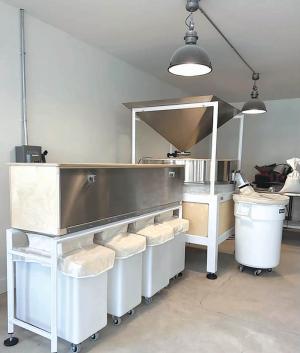
Heyn makes mills with three stone sizes: 26, 40 and 48 in. The company also makes flour sifters that can be adjusted to remove the desired amount of bran.
He uses Vermont-quarried natural Barre Gray granite stones. This specific type of granite is favored by sculptors and millers because of its ideal carving capacity. Granite is preferred for milling due to its high thermal capacity, which keeps temperatures low during the process. This is essential for protecting nutrients during milling.
New American Stone Mills start at $15,000 for the 26-in. stone. The sifter costs $5,000. The 48-in. stone mill and sifter are priced at $40,000. A recent installation in California was for One Mighty Mill. It included four 48-in. mills and a sifter, along with a pneumatic system to transport the flour to the sifter and packager. The system can produce up to 60,000 lbs. of fresh-milled flour per week.
“Many of our customers have started with the small mill and then scaled up as their business grew,” says Heyn. “One Mighty Mill started in Boston with fresh-milled flour and was selling on both coasts. They found it was important to have regional operations.”
Heyn teaches milling and mill maintenance, including the Art of Dressing Millstones, at schools across the U.S. and Canada, such as the Washington State University Bread Lab (Vol. 38, No. 2) and the Northern Crop Institute (NCI) (Vol. 49, No. 3).
While the business initially served bread bakers like them (Marvin still is one), its customer base expanded during COVID.
“Everyone was home baking, and flour was in short supply,” says Heyn. “We had farmers contacting us who were sitting with grain and saw local market potential. More and more, they’re becoming part of our market.”
Heyn advises farmers who are considering milling to identify their target market.
“Who will you sell to?” asks Heyn. “Will it be the local community, retail or online? You need to be able to tell your story, explain what the farm does, and how you work with Mother Nature. You also have to understand and be able to explain the variations in flour that come with different grains from year to year.”
A good way to learn more about the mills is to attend a workshop at a place like NCI, which has a New American Stone Mill.
“I’ll be doing a workshop with Amrita Ray at NCI in November,” says Heyn. “We’ve probably gotten at least eight sales from past NCI students.”
The FAQ page on the company’s website offers a thorough overview of the mills, including training, installation and maintenance.
Contact: FARM SHOW Followup, New American Stone Mills, 559 Harrel St., Unit B4 AA, Morrisville, Vt. 05661 (ph 802-279-8833; newamericanstonemills@gmail.com; www.newamericanstonemills.com).
Click here to download page story appeared in.
Click here to read entire issue
Stone Mill Maker Also Teaches Milling
Andrew Heyn was a bread baker first, then became a wood-fired oven builder, and eventually a stone mill maker. For Heyn and his wife and business partner, Blair Marvin, it was a natural progression. In 2004, they started Elmore Mountain Bread using a wood-fired oven. When that oven began to fall apart, the transition began.
“I had ideas on how to improve on it,” says Heyn. “I designed a wood-fired oven with a friend, which led him to build ovens across the country for other bakers.”
Another friend started Heyn and Marvin on the next step in the process. He had a stone mill built in Austria and introduced them to fresh, stone-milled, whole-wheat flour. They were immediate converts and wanted their own stone mill.
“The only one that used granite stones in the U.S. had them vertical, and we wanted one that was horizontal,” says Heyn. “It took me about a year of research into how mills were made in the past, when manufactured in Europe and made with granite. I had to figure out how to size everything properly. With the help of an engineer and a welder, we built one.”
It took the baking pair another six months to transition from the flour they had used to fresh stone-ground flour. Their friends in the baking community noticed the difference.
“They began asking me to build mills for them,” says Heyn. “I built our first one in 2014, and by 2015, we had established New American Stone Mills. In the past 10 years, we’ve shipped out 265 mills. We’re getting close to having one in every state and have at least 30 across Canada, several in Australia and several in the U.K., as well as Ireland and the Czech Republic.”
Heyn makes mills with three stone sizes: 26, 40 and 48 in. The company also makes flour sifters that can be adjusted to remove the desired amount of bran.
He uses Vermont-quarried natural Barre Gray granite stones. This specific type of granite is favored by sculptors and millers because of its ideal carving capacity. Granite is preferred for milling due to its high thermal capacity, which keeps temperatures low during the process. This is essential for protecting nutrients during milling.
New American Stone Mills start at $15,000 for the 26-in. stone. The sifter costs $5,000. The 48-in. stone mill and sifter are priced at $40,000. A recent installation in California was for One Mighty Mill. It included four 48-in. mills and a sifter, along with a pneumatic system to transport the flour to the sifter and packager. The system can produce up to 60,000 lbs. of fresh-milled flour per week.
“Many of our customers have started with the small mill and then scaled up as their business grew,” says Heyn. “One Mighty Mill started in Boston with fresh-milled flour and was selling on both coasts. They found it was important to have regional operations.”
Heyn teaches milling and mill maintenance, including the Art of Dressing Millstones, at schools across the U.S. and Canada, such as the Washington State University Bread Lab (Vol. 38, No. 2) and the Northern Crop Institute (NCI) (Vol. 49, No. 3).
While the business initially served bread bakers like them (Marvin still is one), its customer base expanded during COVID.
“Everyone was home baking, and flour was in short supply,” says Heyn. “We had farmers contacting us who were sitting with grain and saw local market potential. More and more, they’re becoming part of our market.”
Heyn advises farmers who are considering milling to identify their target market.
“Who will you sell to?” asks Heyn. “Will it be the local community, retail or online? You need to be able to tell your story, explain what the farm does, and how you work with Mother Nature. You also have to understand and be able to explain the variations in flour that come with different grains from year to year.”
A good way to learn more about the mills is to attend a workshop at a place like NCI, which has a New American Stone Mill.
“I’ll be doing a workshop with Amrita Ray at NCI in November,” says Heyn. “We’ve probably gotten at least eight sales from past NCI students.”
The FAQ page on the company’s website offers a thorough overview of the mills, including training, installation and maintenance.
Contact: FARM SHOW Followup, New American Stone Mills, 559 Harrel St., Unit B4 AA, Morrisville, Vt. 05661 (ph 802-279-8833; newamericanstonemills@gmail.com; www.newamericanstonemills.com).
To read the rest of this story, download this issue below or click
here to register with your account number.