

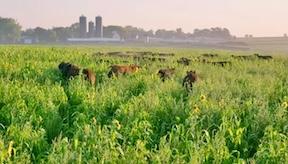
Karl Palmberg raises high-quality beef and gives the credit to his very diverse pastures. Where his pastures once were mostly smooth brome, he’s now likely to plant a dozen or more species in a given pasture.
“I push to maximize diversity in the forage I give to my finishers,” says Palmberg. “Energy puts on the marbling. It gives my calves a good rate of gain and gives my customers a good eating experience. With nutrition and high energy, you get something really good.”
As a result, he’s increased his direct sales of beef from 15 head to 40 to 50. Rebel Pastures, an online marketer of pasture-fed beef, takes everything else he can produce. Demand for his beef wasn’t always there.
When Palmberg returned home after more than 10 years as a fighter pilot, raising beef wasn’t part of his plan. He had a full-time day job and intended to do traditional row-crop farming on the side. His interest in regenerative agriculture changed that plan: he switched from conventional tillage to strip-till and added a cow herd to help improve the soil biome.
Palmberg started his cow herd in 2016 with 13 head from grass-fed producers. He began learning how producing grass-fed beef differed from finishing cattle on grain. At one point, he sold a quarter of his beef to friends known for their very good palates.
“They told me it was gamey with not very good marbling, and they didn’t like it at all,” says Palmberg. “They ended up giving it to their dog.”
He decided to focus on producing good-tasting grass-fed beef and turned to the Bionutrient Food Association and the Utah State Beef Quality Program, which he credits as good sources of information. He began providing his finishers with separate forage from that of his cow-calf herd. He also invested in virtual fencing for rotational grazing.
“I started with Gallagher fencing collars, and this past spring, Monile came to us to try their collars,” says Palmberg. “They have a collar system similar to Halter, with above-the-shoulder systems and small counterweights underneath.”
The biggest change was in the forage. His traditional pastures were dominated by smooth brome. With grazing, he began to see clovers and alfalfa come in. With more intensive grazing, he is now seeing some natives, such as big and little bluestem, summer perennials, and native pollinators, including various types of asters. He also started planting summer annuals, such as sorghum-sudan, in mixes with other species.
“In 2025, I did a custom mix using the SmartMix Calculator on Green Cover’s website,” says Palmberg. “I went with some of everything that’s good for summer grazing, and it drove the guys at Green Cover crazy. The final mix was similar to what they now sell as their Soil Builder, with 11 different species designed for improving soil organic matter.”
The mix was a diverse blend of legumes, grasses, brassicas and broadleaves.
“I wanted the diversity for the soil biome as well as for the cattle,” says Palmberg.
As his finishing pastures have improved, so have his cattle, in both rate of gain and quality.
“I’m getting them finished in under 2 years, and this past year they put on 2 1/2 lbs per day,” he says.
Palmberg calves in early April or late March and doesn’t wean them until the following February. He creep-feeds them with forage.
“Using the collars to hold the cows back, the calves can graze fresher grass,” says Palmberg. “I’ll also bring out oats and barley that have been spring-cut, baled and wrapped. This year, I’ll be feeding corn silage as well.”
He practices line breeding but doesn’t select for phenotype as many grass-fed producers do. Palmberg focuses on fertility first, then on the eating experience on the back side.
“I’ve seen an incremental increase, almost exclusively from forage management,” he says. “I’ve gotten super feedback from customers and feel the high-energy, forage-based diet has really made a difference. I now have people who are frustrated when I don’t have beef for them.”
Contact: FARM SHOW Followup, Sunlight and Rain Farm, 1339 100th St., Larchwood, Iowa 51241 (ph 605-553-2408; www.sunlightandrain.com).