

Pulling heavy black poly well pipe to retrieve a submersible without crimping it can be tricky. Dale Freeman designed a DIY puller that makes the job easy. The pipe is guided out of the casing through flanged hubs. Over the past 20 years since building his first one, he’s made several more for himself, friends and neighbors.
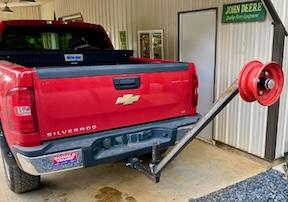
“I like being prepared for whatever happens,” says Freeman. “I built one for an excavator buddy who wanted to slide it into the receiver hitch on his truck. Most of the time, he just backs it up to the well.”
Freeman’s puller starts with a bracket that locks onto the well casing. The bracket is 6-in. wide channel iron that faces the casing. It creates a valley with sides that match the casing pipe’s radius. Freeman locks it in place with two pieces of round stock that extend into the casing.
The round stock pieces are welded to a short length of round stock, which is welded to a 4-in. wide flat piece of steel with a slot cut in it. A matching flat steel plate with a hole in it and a nut welded under the hole is welded to the top of the channel iron. Once the bracket is in place, a bolt through the slot to the nut locks the round stock and the bracket in place.
“The round stock pieces are beveled on the ends to prevent damage to the pipe, as well as wires running to the pump,” says Freeman. “I also use a ratchet strap at the bottom of the bracket to further lock it in place.”
Two lengths of 1 by 2-in. rectangular tubing are welded to the sides of the channel iron to form vertical legs. One flanged hub rides on a 3/4-in. bolt through the top of the legs.
A second set of 1 by 2-in. tubing is welded at an angle away from the vertical legs. A second flanged hub rides on a bolt through the ends of the tubing. Lock nuts on the bolts allow the hubs to spin free.
The flanged hubs are modified 2-piece cart wheels Freeman purchased at Harbor Freight. The sides were bolted together with the rubber tires in between. He cut away the rubber tires, but the hubs weren’t wide enough to fit the well pipe.
“I used short pieces of 2-in. PVC pipe as spacers between the sides of the wheels and locked the sides together with bolts through the existing bolt holes to create the flanged hubs,” he says. “The spacers were sized to allow the pipe to fall in between the flanges.”
For his excavator friend, Freeman simply mounted a flanged hub to a trailer axle spindle. The spindle mounted to 1 1/2-in. square tubing that fit 2-in. square receiver hitch tubing. The square tubing with the flanged hub angles up and away from the bumper hitch. Secured to the truck, it doesn’t need to be bracketed to the well casing.
Contact: FARM SHOW Followup, Dale Freeman, Monroe, Va. 25474.