

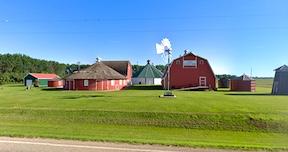
Some people collect vehicles, tools and equipment from the past. Jim and Joan Lacey collect barns and fill them with vehicles, tools and equipment. All of it can be seen at the Little Village Farm, the private museum they open to the public.
“We moved to our farm in 1976, and not long after, a neighbor suggested we rescue a round barn at risk of being washed away by the nearby river,” recalls Jim Lacey. “Since then, we’ve added 10 buildings to the farm for a total of 13. One was a chicken house from an orphanage farm run by the local Odd Fellows lodge.”
An older barn was built on site, as was the newest and most unique. It has 16 12-ft sides. It measures 63 ft across and is 25 to 30 ft high at the roof. Lacey designed and built it to showcase five windmills, three tractors, a few signs, and a pre-1900 horse-drawn grain header. About 10,000 baseball-type caps line the ceiling.
The round barn was designed for hog sales. To build it, every board was soaked and bent in a jig.
“It was used from 1915 to 1935,” says Lacey. “Hogs were run up a ramp to a 5-ft high sales platform, sold, and run back down another ramp to the other side for shipping out. We got to it just ahead of a bulldozer.”
Another barn was a kit barn built by a South Dakota company. Still another once housed breeding stallions. After moving it, a cousin asked whether he’d saved the planks for the horses to stand on to protect their hooves.
“We went back and dug a trailer load of them out of the straw,” says Lacey. “We used some for steps in the home Joan designed and we built.”
Joan and a niece spend about 2 days each spring vacuuming and dusting before the museum opens. Periodically, she holds a rummage sale to sell extras.
“We find a lot of things, later realizing we have duplicates,” she explains. “If we can sell some, it makes some money for the museum.”
For the Laceys, the barns aren’t just buildings. They’re part and parcel of local agricultural history, and they collect stories with each one. Talk to Lacey for a bit, and it’s clear that it’s the history that he truly loves.
The barns are filled with artifacts from rare tractors, such as the Shepphard, and an old well-drilling truck with its rig, engines and pumps. Thousands of tools, toys and engines are on display for visitors. While most date from the mid-1800s to the mid-1900s, a few date back to the 1600s.
The kitchen barn contains more than 200 jars, a wood-fired cook stove, hand and power-operated washing machines, butter churns and much more.
“Joan and I were pickers before it became popular,” says Lacey. “We’re trying to preserve history.”
A big part of the history they hope to preserve is how the barns were built and used, as well as how the artifacts within them were used.
The Laceys offer tours of the barns and their contents, charging adults $10 each. Visitors often share bits of their lives as well. Some also contribute to the collection.
Perhaps the most obvious and appreciated gifts the Laceys have received are the caps lining the ceiling of the 16-sided barn.
“Joanie lost her hair when treated for cancer, and people started giving her hats,” says Lacey. “They really make the acoustics better. However, I think we have enough now; no more caps, please.”
At 85, Lacey and his wife continue to add to their collections of items and stories from visitors, preserving their history. The future is less certain.
“We put it all together with our own nickel,” he says. “We’ve offered it to people, but even public museums are having a tough time. Our niece and possibly a nephew are interested.”
The Laceys love to share their collections of barns and artifacts with visitors. They don’t have regular hours. Just stop by the house for a tour. They prefer that people call ahead, if possible. That’s especially true for groups.
Contact: FARM SHOW Followup, Little Village Farm, 47582 240th St., Dell Rapids, S.D. 57022 (ph 605-428-5979).