

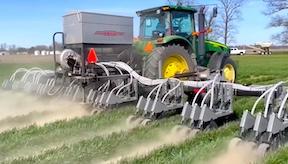
Harvesting wheat while releasing soybeans to canopy and thrive is easy for Jason Mauck, thanks to a few simple attachments. The customized fenders push down alternating strips of soybeans, while the draper head harvests the winter wheat.
“I use Flexxifinger Crop Lifter brackets on the header with two types of attachments to push down the soybeans,” says Mauck. “They let me cut the wheat at 8 to 10 in. heights when the beans are already about 18 in. high. This really opens up the soybeans to sunlight.”
This spring, Mauck planted soybeans between strips of wheat planted the previous fall. The wheat was planted in twin rows with 15 in. spacing, leaving gaps to be filled with soybeans.
When spring arrived, he set the row spacing on his Hiniker air seeder to deliver twin rows at either end of the toolbar, two sets of five rows in the center, and three sets of triple rows in between.
“The two sets of five rows with wheat between them are set inside the wheel spacing of the combine,” explains Mauck. “We plant the soybeans early, when the wheat is only about 8 in. tall, so even if we run over some, it recovers fine.”
His strategy is to plant wheat thin and wide, then cram as many soybeans as he can into the gaps. He uses a quarter of the wheat seed and half the soybeans he normally uses for double-crop soybeans.
“I want to leave 8 in. between the bean seeds and the wheat root ball,” he says. “We want to get substantial soybean root mass so it can compete with the wheat at grain fill, when it gets really thirsty.”
Mauck explains that wheat pulls out excess moisture and shades competing weeds. His goal is not to maximize wheat or soybean yields but to maximize profit per acre. Sometimes he does both.
“We shoot for 60 to 80% of expected double-crop wheat yields and full or higher soybean yields,” says Mauck. “Last year, our relay soybeans beat our monocrop beans by two bushels per acre across our farm.”
Mauck used Flexxifinger bean shields over the soybean rows between the combine wheel tracks and over the end rows. Remaining soybean rows were pushed below the draper bed cutting bar using shop-made PVC pipe.
“The bean shields were left over from a 2018 investment, but I didn’t want to spend the money on more of them,” says Mauck. “I fabricated the PVC deflectors by mounting a smaller pipe between Flexxifinger crop lifter brackets with a slightly larger PVC pipe on it. The larger pipe rolls free on the bracketed one to take the friction out.”
When it came time to harvest the wheat, Mauck hosted his annual Farm Weird field day for other farmers interested in relay cropping. Attendees saw firsthand how the deflectors worked and walked through the harvested wheat strips, which yielded 83 bushels per acre.
Contact: FARM SHOW Followup, Mauck Farms, 5101 800 N, Gaston, Ind. 47342 (ph 765-215-4528).