

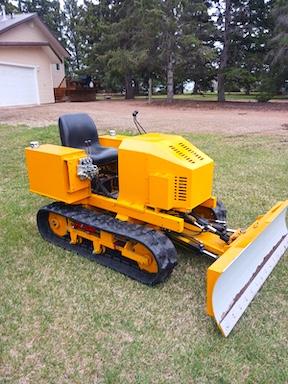
Brian Bedard’s lifelong dream of owning a small Caterpillar finally came true after he retired.
“I always wanted a small dozer but kept putting it on the back burner,” Bedard says. “After I retired, I figured I had the money to tackle the project, so I decided to do it.”
He, a former farmer and founding partner of an equipment company, began by sketching designs in the SolidWorks modeling program, basing his mini dozer on a Mitsubishi track hoe he owned.
As a self-proclaimed builder and “College of Hard Knocks” graduate, Bedard was practical, sourcing rubber tracks from a supplier in Edmonton, Alberta. He built custom track drive sprockets and devised a more affordable drive system using a standard hydraulic motor and chain reduction instead of pricier wheel motors. The frame was precision-cut at a laser shop.
“I assembled the whole unit like a puzzle, only making a few modifications along the way,” he says.
Although a load-sensing, pressure-compensating pump was out of budget, Bedard engineered a reliable, closed-center hydraulic system with variable speed and a built-in flow divider. All components are standard off-the-shelf parts. The main pump is direct-driven for the tracks, while a smaller belt-driven pump operates the nearly 5-ft wide blade. Power comes from a new 25-hp Honda engine he purchased.
The compact Caterpillar easily pushes piles of dirt, gravel, brush and snow. Built over one winter and later refined, it’s become a family favorite for odd jobs.
“We use it for the strangest things,” Bedard laughs. “My grandkids even give the great-grandkids rides on it.”
Bedard invested about $8,000 to $10,000 in the mini-dozer project, far less than the $35,000 to $40,000 price tag for commercial garden tractors.
Contact: FARM SHOW Followup, Brian Bedard, St. Brieux, Sask. S0K 3V0 (ph 306-921-9026).