

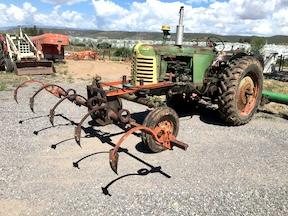
End rows are a pain when digging furrows in a field for gated pipe irrigation. Rear-mount toolbars with spades for furrows are fine for the rest of the field. However, doing end rows with one requires constant over-the-shoulder backing up and matching the toolbar to the pipe openings. Greg Krush had a better idea.
“I got the idea from a friend to mount a toolbar on the front of a tractor,” says Krush. “The spades are set so I can drive up to the gated pipe, drop them down and drag the furrows straight back to meet the ones in the field.”
Krush’s toolbar mounts to the tractor with 3 by 4-in. angle irons bolted mid-frame. At the front of the tractor, the angle irons float on an angle iron crossbar bolted to the front end plate.
“The crossbar allows the angle irons to pivot if the toolbar rides up,” says Krush. “It has two vertical arms made from square tubing to help guide the angle irons as they ride up and down.”
A short length of angle iron welded to the ends of the angle irons connects them and serves as a base for a hydraulic cylinder that activates the toolbar.
The toolbar has five spring-tooth shafts with spade ends mounted to a 2 by 2-in. square steel bar. The bar rides inside two short lengths of 3-in. dia. pipe. The pipes, in turn, are mounted in 6 by 12-in., 3/8-in. steel plates that hang down from the long angle irons. A second length of angle iron is welded to the two plates to stabilize and brace them.
“The hydraulic cylinder ram is pinned to a piece of steel welded to the toolbar,” explains Krush. “When it’s extended, the toolbar rotates, lifting the spades out of the ground. When it retracts, the spades float at ground level. When I back up, they dig in as they’re dragged backward. The weight of the toolbar and the angle of the spades are all that’s needed to create furrows.”
The Oliver 88 is one of more than a dozen older Olivers that Krush owns. He doesn’t just collect them. He uses them.
The 88 is his gated pipe marker tractor. In addition to the front-mounted toolbar, he has a Mormon creaser on the back 3-pt. It’s simply a length of gated pipe with spades attached at the gates.
“I have implements mounted on different tractors,” says Krush. “Almost every one has a 3-pt. implement of some kind, ready to be used when I need it.”
Contact: FARM SHOW Followup, Greg Krush, 30976 L Rd., Hotchkiss, Colo. 81419 (ph 970-872-2343; gregkrush@cs.com).