

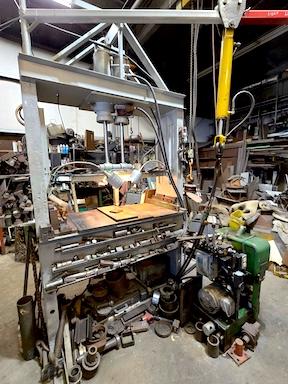
Albert Stier’s 50-ton press can handle any job, from a few inches high to too large to handle by hand. If the 22-in. reach of the paired 5 1/2-in. cylinders doesn’t provide enough flexibility, he can raise or lower the massive steel tabletop. If the workpiece is extra-large, he uses the lift cylinder suspended from a carriage that travels along a 7-ft. long, 2 by 2-in. sq. steel tube that pivots off one end of the press.
“I can set an 8-ft. long beam on the press and work on one end while the rest sticks out about waist high, supported by the lift cylinder,” says Stier. “The other day, a fellow brought in a forklift from a pallet mover. It had a bend in a 2 1/2 by 4-in. beam. I used the lift cylinder to set it on the table, pressed it straight, and sent him on his way.”
Stier is rightly proud that the press was fabricated from virtually all salvaged parts. The vertical posts and the 4-ft. wide, 17-in. deep steel tabletop are channel iron from old bridge beams. The cylinders push against a V-framework welded to the tops of the vertical posts. They pass through and are retained by 8-in. channel iron, which is reinforced with a 3/4-in. thick steel plate to house the cylinders.
“I bought the framework with the tabletop from another welder in the area,” says Stier. “I added the cylinders for the press, the hydraulic pump, and the lift mechanism.”
The cylinders had never been used when Stier got them, but he paid less than salvage.
“We had a John Deere dealer who sold out and was cleaning out the shop before the change in ownership,” recalls Stier. “He found the cylinders under a workbench and offered them to me for $5. I jumped at the deal.”
Other components were mostly scrap leftover from other projects.
“If I see some good potential in something, I don’t throw it away,” says Stier. “I’m 85 years old and have lived here for 60 years. I’ve accumulated a lot of stuff over the years.”
To the right of the press is a 2-hp, 3-phase electric motor that powers a hydraulic pump supplying all three cylinders. The pump and its tank came from an old combine. A two-spool directional control valve from an old loader allows him to engage either the press cylinders or the lift cylinder.
An angle-iron stabilizing bar is suspended from the press rams. It rides between pairs of angle iron welded to the vertical channel iron at either end of the press. Stier attached flex-neck lights to the stabilizing bar.
“The lights ride up and down with the press, so I always have good light on the workpiece,” says Stier. “On one side of the press, I mounted a piece of ruler to indicate if the rams are maxed out. If 9 1/2 in. isn’t enough, I can bring it down to 9 3/4.”
True to his philosophy of using leftovers whenever possible, the lights are encased in cut-off soup cans, which further reflect the light where he wants it.
Stier mounted scrap angle iron to the front face of the press table. The angle iron holds parts and miscellaneous pieces. He keeps sections of steel from an old plow beam on the press table.
“I can stack them or lay them down flat as needed to hold workpieces,” says Stier.
Stier uses the sides of the vertical channel-iron frame facing away from the press, as well as the edges. He welds hooks onto them for hanging chains and adapters.
The chains come in handy if he needs to adjust the worktable. He simply wraps a chain around the table and hooks it to the press. The table is pinned to the verticals and can be lifted or lowered and then re-pinned.
“I don’t have to move the table very often, but it’s an option,” says Stier. “When I built the press, I didn’t think I would use it much, but sometimes I use it twice a day and two or three times a week.”
Stier has contributed several articles to FARM SHOW over the years. At 85, he’s in great health and remains busy.
“If it’s broke, it can be fixed, and if someone made it, I can make it work again,” he says.
Contact: FARM SHOW Followup, Albert Stier, 16067 Newmansville Ave., Petersburg, Ill. 62675 (ph 217-632-2339; cell 217-652-2651).